Plan for the Week
- Evaluate thematic and visual influences from my selected viewing list
- Finalise the narrative format and runtime for the practical project
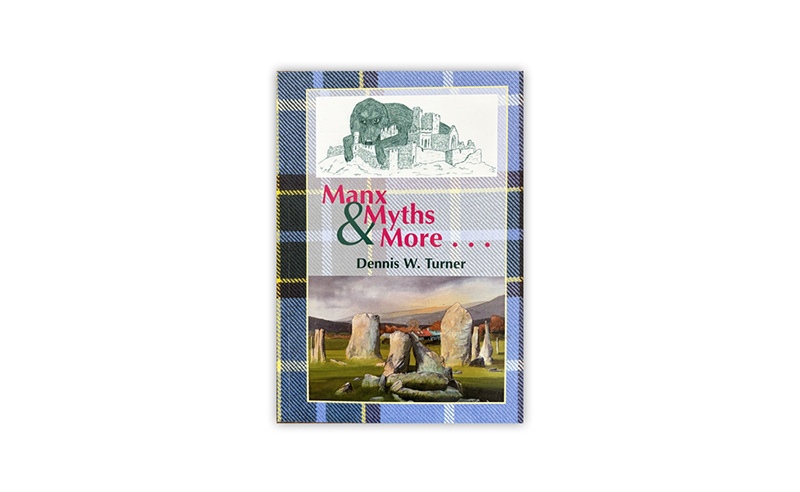
- Extract potential narratives from Manx Myths & More by Dennis W. Turner
- Establish clear goals for prop fabrication within a stop motion environment
Extracting Potential Narratives
Before committing to a storyline, I returned to Dennis W. Turner’s Manx Myths & More to consider which tale would give me the most useful opportunities for physical world-building and graphic props. The Isle of Man has a rich folklore tradition, and several stories offered possible directions. Two other tales initially stood out:
The Moddey Dhoo (The Black Dog of Peel Castle): This is perhaps the most famous Manx legend, centring on a spectral black hound that haunted the guardroom of Peel Castle in the 17th century. From a design perspective, this offered fantastic opportunities for military ephemera. I could have fabricated heavily distressed guard duty ledgers, ancient maps of the castle corridors, and handwritten incident reports.
The Phynnodderee: This tale follows a hairy, incredibly strong sprite who would help farmers with their harvest but was deeply offended if offered clothing as a reward. This narrative would have allowed for a highly rustic, agricultural set design. The props could have included detailed miniature farming equipment, woven baskets, and hand stitched garments, leaning heavily into the tactile nature of textiles and wood.
Selecting the Narrative
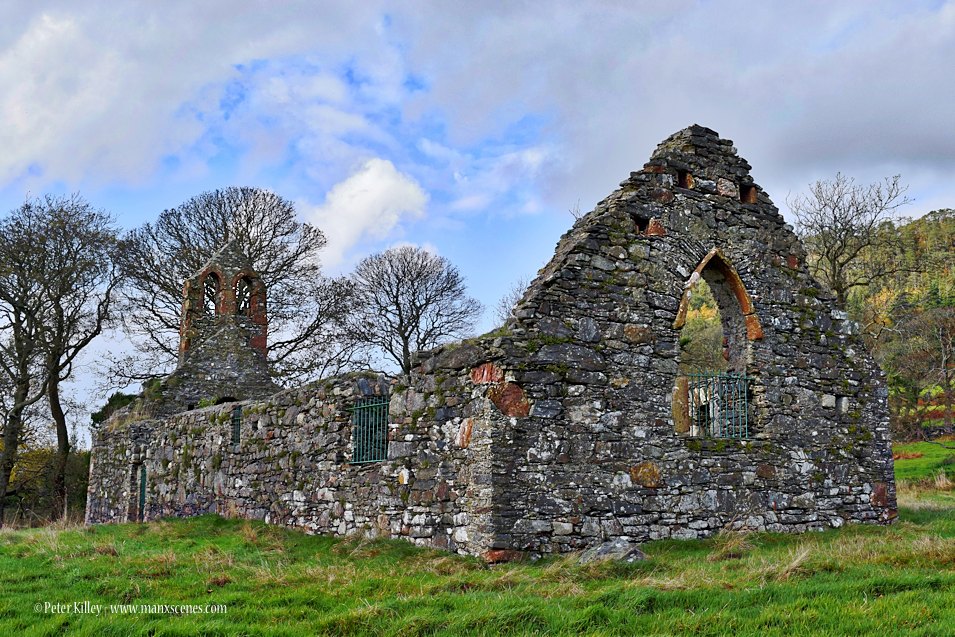
After considering the different options, I decided to move forward with the story of the Buggane of St Trinian’s Church. Alongside its potential for physical world-building, I have a slightly unusual personal connection to it: I played part of the church wall in a primary-school theatre production. That memory made the story feel like an interesting and personal starting point for the project.
The Buggane of St Trinian’s story from Turner’s Manx Myths & More;
A group of monks began to build a church on Mona’s Isle
But when the work was almost through they rested for a while.
Then, down from Greeba Mountain, came the terrible Buggane
And when he saw the roof was on he tore it off again.
Each time the monks rebuilt the roof the Buggane cast it down
And scattered debris far and wide, from Greeba to Marown.
They knew if they could keep the roof intact for just one night
It should remain for evermore; the Buggane put to flight.
Tim Kelly was a tailor and he wagered that he’d stay
And make a pair of breeches and be done by break of day.
As darkness fell he took his place, cross-legged, on the floor.
The roof was firm; his candles lit; a lock was on the door.
But outside there was wind and rain; a ghastly, howling storm.
Then through the chancel floor arose the Buggane’s dreadful form.
The tailor bravely beavered on; the breeches near complete.
The Buggane was frustrated and he stamped his cloven feet.
He clawed at all about him with his hands so thick and coarse
But couldn’t tear the roof off while the vigil was in force.
Then, suddenly, disaster struck; the candles flickered out
And Timothy ran out of thread with the darkness all about.
He hurled a stub of candle at the Buggane’s massive head,
Unlocked the door and, with all haste, off to Marown he fled.
The Buggane smashed the roof apart. He’s had his wicked way
And that is why St. Trinians remains unroofed today.
Stylistic Approach and Format
Although I am using Manx folklore as the starting point, I want to adapt the story rather than reproduce it exactly. I am interested in how Fantastic Mr. Fox takes an existing story and translates it into a very controlled visual and comic world. I don’t want to imitate the film directly, but I do want to explore a similarly dry tone, deliberate framing and contrast between dramatic events and restrained character reactions.
Because stop-motion production and puppet fabrication are extremely time-consuming, I have decided that a complete short film would be unrealistic within the module. My current plan is therefore to produce a pre-production and proof-of-concept package. This could include an animatic, selected physical props, character models and short movement tests. I am also considering voice acting, as narration and vocal performances might help establish the dry comic tone without requiring extensive lip-sync animation.
Focusing on the Graphic Props
Even with the move towards a proof of concept, I need to keep the original research question at the centre of the project. The graphic props should not become decoration added after the story has been developed; they need to contribute to the characters, setting or narrative.
The story offers several possible pieces of ephemera, including hand-drawn architectural plans, a formal complaint from the Buggane and painted construction or boundary markers. Some of these objects may use artistic licence rather than strict historical accuracy. By making and photographing a selected group of props, I can explore whether their physical materials help the proposed world feel more believable.
Methodology and Process
Because the project depends on how physical props behave under lighting and close-up photography, an iterative process will be important. I plan to use Donald Schön’s idea of ‘reflection-in-action’ as one way of documenting the decisions I make while working with the materials.
For example, I can print and manually age the architectural plans before viewing them through the camera. If the paper looks too clean, the ink appears too flat or the distressing becomes excessive, I can adjust the process and test it again. My secondary and primary research suggests that material details can become more noticeable under close photography, but the making process will allow me to test that idea rather than assume it is always true.
Defining the Visual Rules
To keep the proposed world visually consistent, I need to define some of the terms and principles guiding the project. These are working definitions rather than fixed rules, and I expect them to develop once physical production begins.
Tactile Ephemera: For this project, this describes graphic props that are physically produced or finished, such as architectural plans, notices and signs. Their paper, ink, surface wear and construction should be visible rather than simulated entirely through digital effects.
Epistemic Monitoring: I am using this term to describe the way viewers may assess whether details within a fictional world feel consistent or believable. An obvious visual mismatch, such as very modern typography on a supposedly historic object, could draw attention away from the story. This does not mean every viewer will notice every error, but it gives me a useful way to think about visual consistency.
Narrative Transportation: This describes the audience becoming mentally and emotionally absorbed in a story. Within this project, I want to explore whether consistent, tactile graphic props can support that experience. The props will only be one part of this process, alongside the story, characters, sound, framing and performance.
Crazy 8s Ideation Session
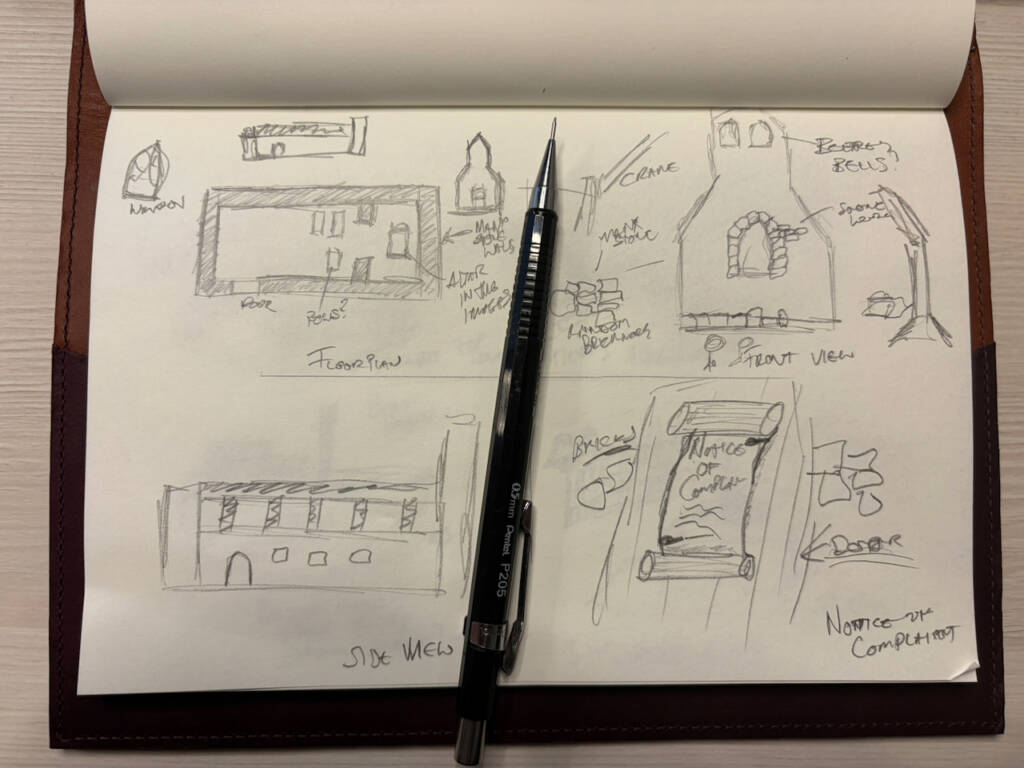
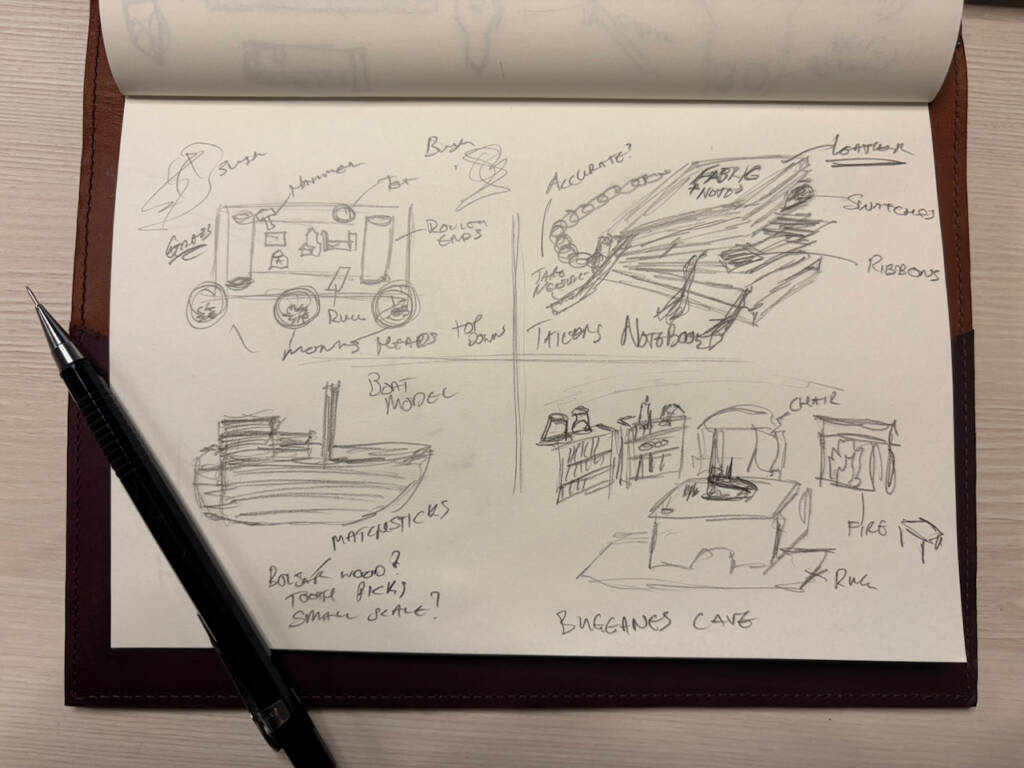
To move away from the research and begin generating visual ideas, I completed a quick ‘Crazy 8s’ sketching exercise. I divided two pages in my sketchbook into eight panels and gave myself eight minutes to sketch ideas for what the hero props could look like and what they could be.
I explored several approaches, ranging from rough hand-drawn plans to more complex pseudo-scientific diagrams. The exercise suggested that an imperfect, hand-drafted approach might suit the folklore and physical production better than a precise digital recreation. I now need to research suitable visual references before deciding how historically informed the final props should be.
Presentation Prep
Next week, I need to present my project direction to the panel. I want to keep the slides visually striking but academically grounded. I have outlined the core narrative of my pitch:
- The Origin: My interest in cinematic world-building, combined with my connection to Manx culture and folklore.
- The Problem: Inconsistent or unconvincing background graphics can attract attention and potentially disrupt the audience’s engagement with a fictional world.
- The Research: Interviews with Flora Fricker and Thomas Love, alongside responses from my public survey, indicate that both professionals and general viewers pay attention to background details.
- The Response: A proof-of-concept package for a comedic stop-motion adaptation of the Buggane of St Trinian’s, supported by selected tactile props and character experiments.
- The Objective: To explore how physical materials and carefully designed graphic props can support storytelling and contribute to a convincing fictional world.