Final Outcomes and Reflection
With the practical production now complete, I wanted to bring the finished outcomes together in one final post. The project originally began with the intention of producing a short stop-motion film based on the Buggane of St Trinian’s, but it eventually developed into a proof-of-concept package containing puppets, graphic props, miniature environments, a script and a storyboard.
Although I was not able to produce every element originally planned, the completed objects demonstrate the proposed visual world and the relationship between graphic design, physical materials and stop-motion production.
The Buggane Puppet
The Buggane puppet became the main character outcome for the project. It was constructed using a twisted aluminium-wire armature, foam, toy stuffing and raw wool, with resin-printed components used for the head, faceplates and hands. The hooves began as a physical clay sculpt before being scanned, refined digitally and printed.
The interchangeable magnetic faceplates provide four different expressions: resting, resting with closed eyes, blowing and anger. Although the visible seams and limited range of hand positions would require further development for full animation, the system demonstrates how the character could communicate different emotions.
The puppet can stand and hold static poses without external support. However, because formal motion tests were not completed, I cannot claim that the armature or fur would remain consistent throughout sustained animation.
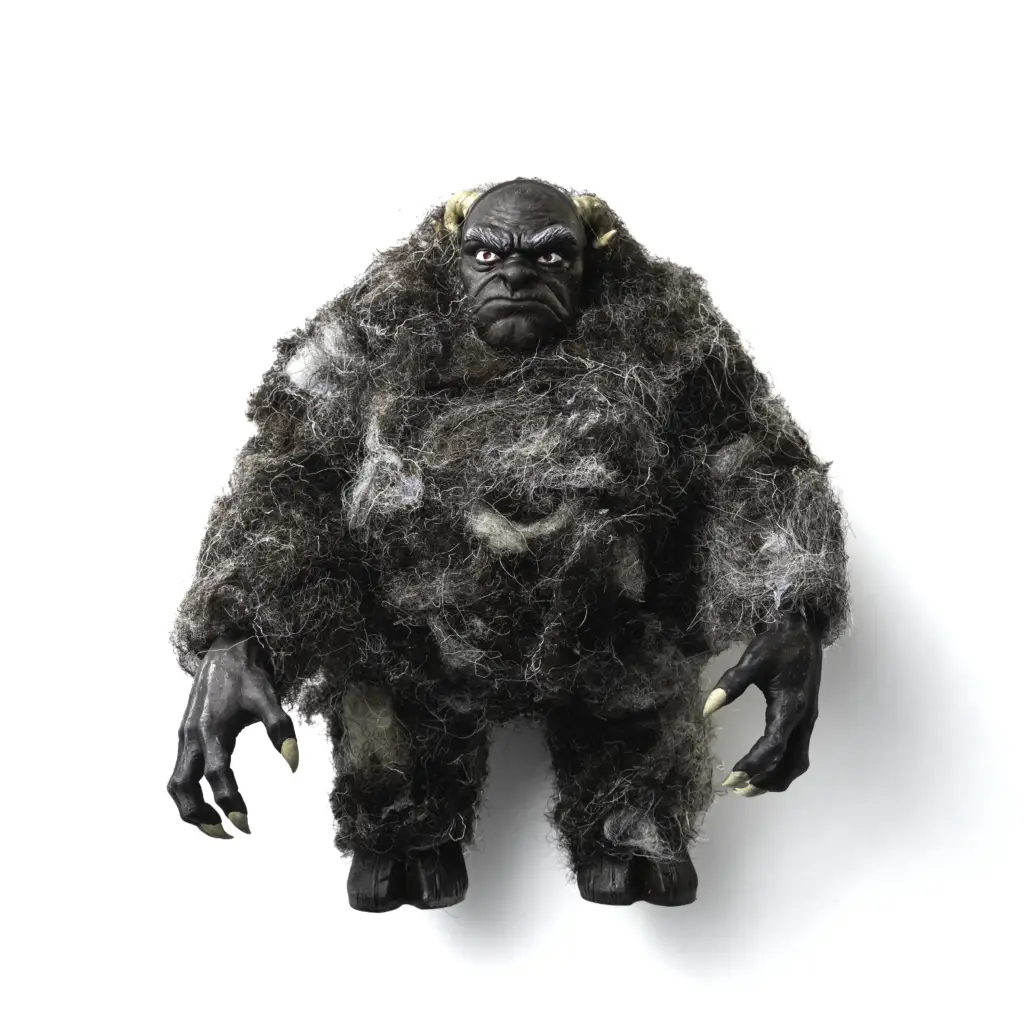
Completed Buggane puppet showing the full body, fur and final proportions.
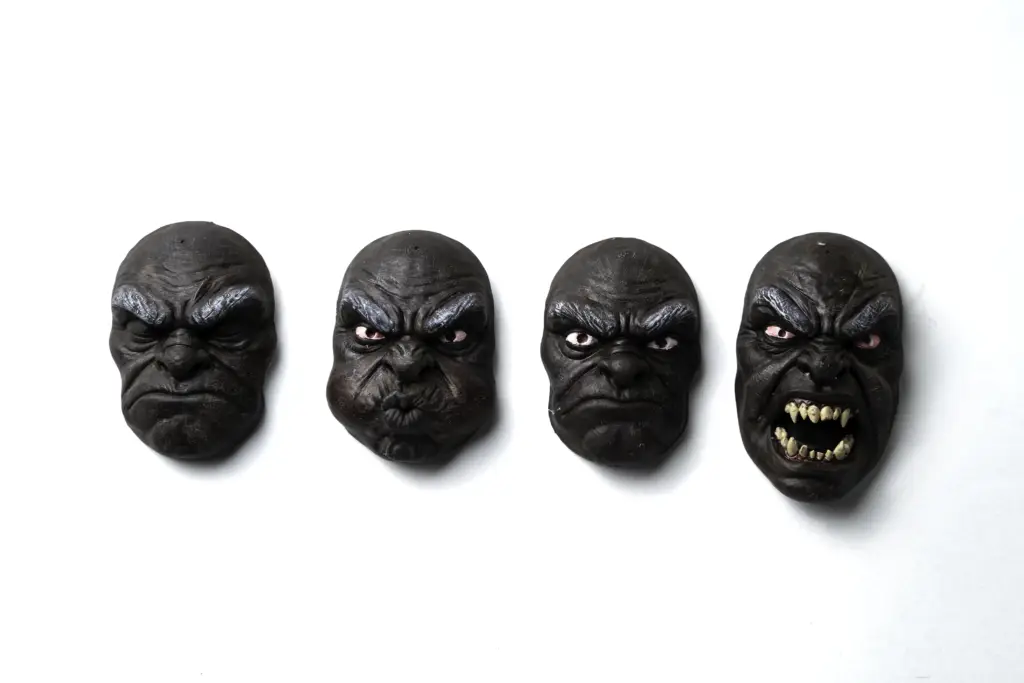
The four magnetic faceplates created for the Buggane’s different expressions.
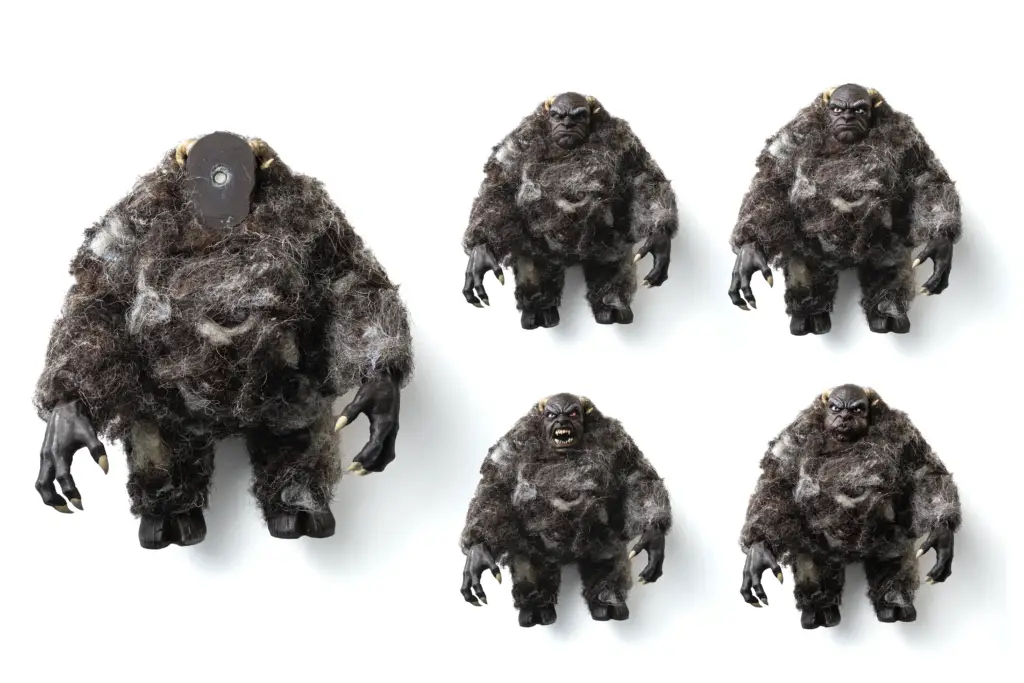
Close-up details showing the combination of resin printing, hand painting, wool and clay-derived components.
The Monk Puppets
I produced three monk bodies to establish their different proportions and show the intended scale difference between the human characters and the much larger Buggane. All three bodies have completed armatures, foam construction, painted heads and sandal components.
Two of the monks were given fabric robes, hoods and rope belts. The third body remained unclothed, allowing the underlying construction and proportions to remain visible.
The monk hands were not completed. I had originally delayed making them until the specific poses and accessories required for the motion tests had been confirmed. When the project scope changed and the motion tests were removed, there was not enough time to develop a suitable set of interchangeable hands. For the final photographs, the sleeves can be arranged to suggest that the hands are hidden inside the robes, but this would need to be resolved properly before animation.
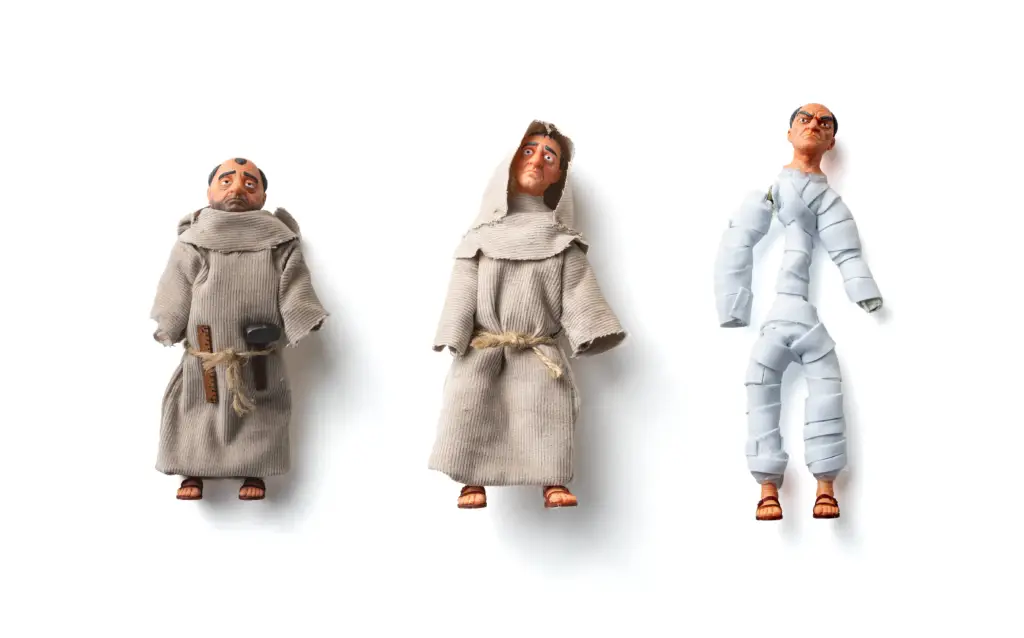
The three constructed monk bodies, including the two clothed characters and the remaining uncovered armature.
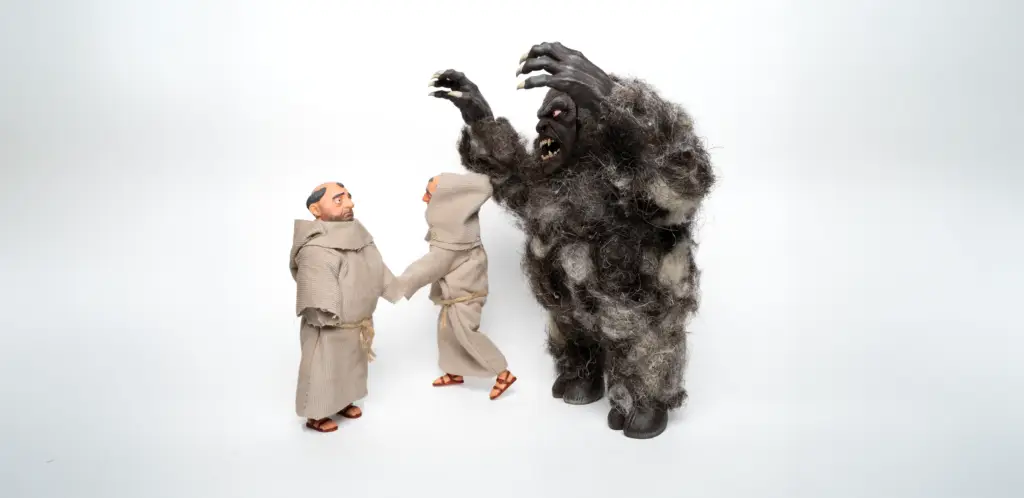
The clothed monks staged beside the Buggane, demonstrating both the intended difference in scale and the planned relationship between the characters.
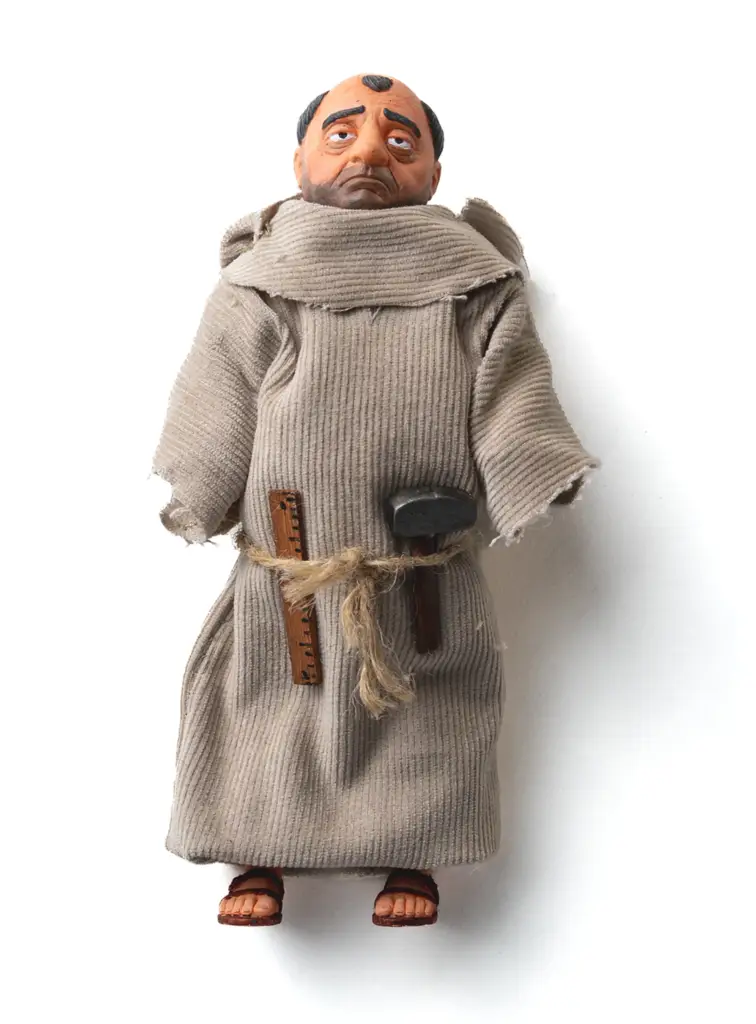
The completed ‘Realist’ monk, showing the fabric robe, rope belt, painted resin head and sandal components.
Church Architectural Plans
The church architectural plans became one of the main graphic props. I began with references including the Plan of St Gall and the sketchbook of Villard de Honnecourt, while recognising that neither provided a direct model for twelfth-century church construction on the Isle of Man.
The finished documents should therefore be understood as historically informed props rather than accurate reproductions. I combined digital layout work with tea-stained paper, pencil tracing, quill-drawn lines and handwritten annotations. Dark red and black inks helped separate the architectural structure from the smaller notes and sketches.
Some of the smallest writing became difficult to read once the plans were reduced to the scale of the puppets. It still provides visual texture, but the legibility would need further testing if the document were shown in an extended close-up.
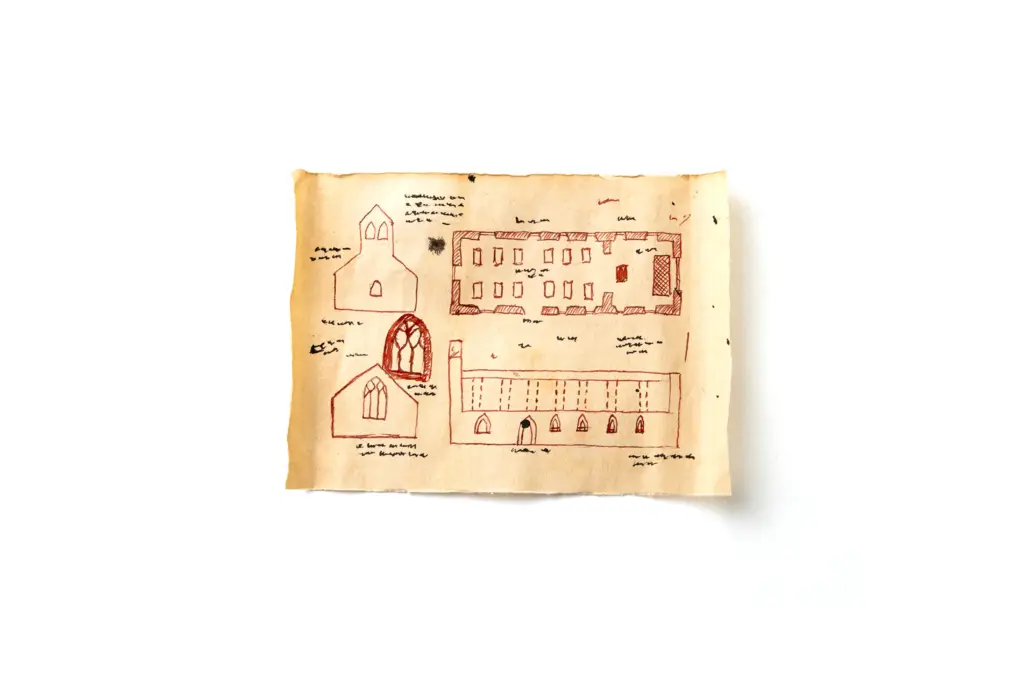
The completed church architectural plans, combining elevations, layouts, geometric studies and handwritten annotations.
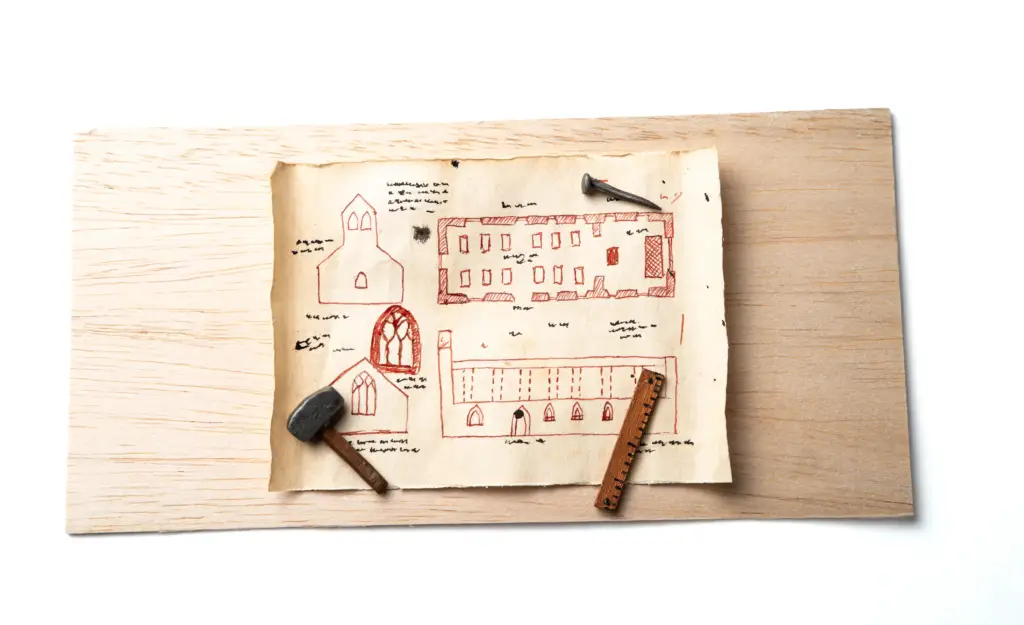
Close-up detail showing the tea-stained paper, red architectural lines and black annotations.
For this final photograph, I returned to the top-down composition first explored during the Crazy 8 exercise and later developed through AI-assisted concept art. I recreated the scene using the finished monk puppets and architectural plans, adding the miniature hammer, ruler and nail to make the table feel like an active construction workspace. Although the final photograph is simpler than the concept image, it shows how the early visual idea translated into physical props and scale.
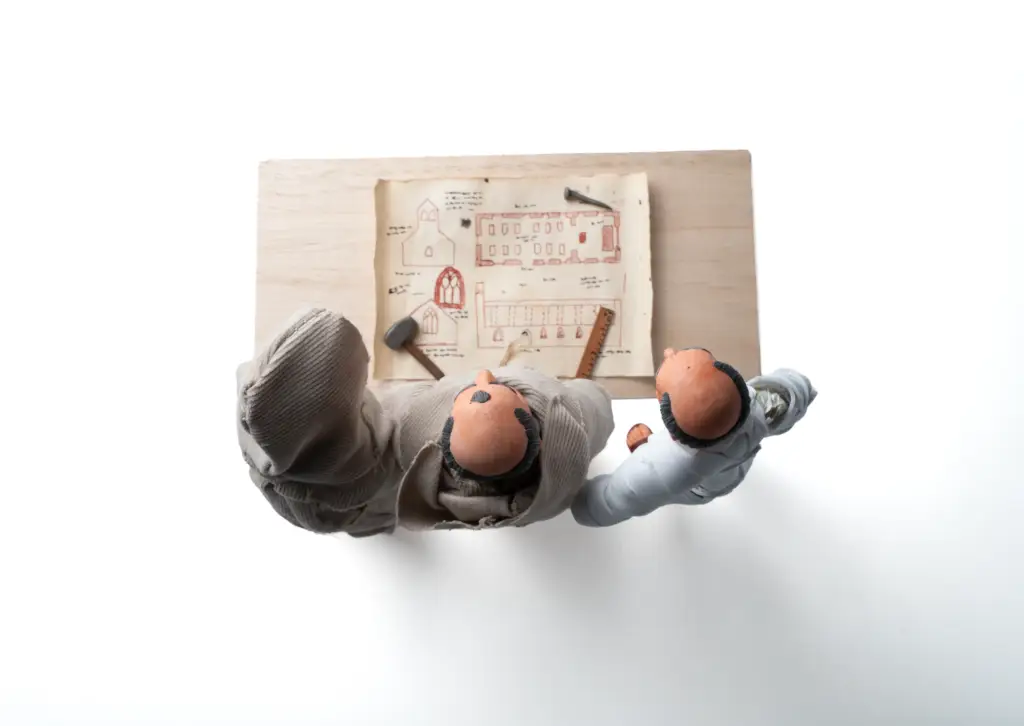
The finished architectural plans staged with the monk puppets and miniature construction tools, revisiting the top-down composition first explored in the Crazy 8 sketch and AI-assisted concept art.
Official Notice of Complaint
The Official Notice of Complaint was created as a deliberate comic anachronism. The Buggane behaves as though he is issuing a formal legal notice to the monks, despite the document not being based on a genuine medieval form of complaint.
I used LTC Goudy Text as a stylistic starting point because its blackletter appearance suited the tone of the project, although the typeface itself is not historically accurate to the setting. The lettering was printed, traced and redrawn by hand on tea-stained paper. This allowed the final prop to retain the intended typographic structure while introducing physical ink variation and surface texture.
To give the notice a setting, I created a small section of the church wall and door from high-density foam. Each stone was individually carved and textured before being painted. The notice could then be attached to the door in the position it would occupy within the proposed film.
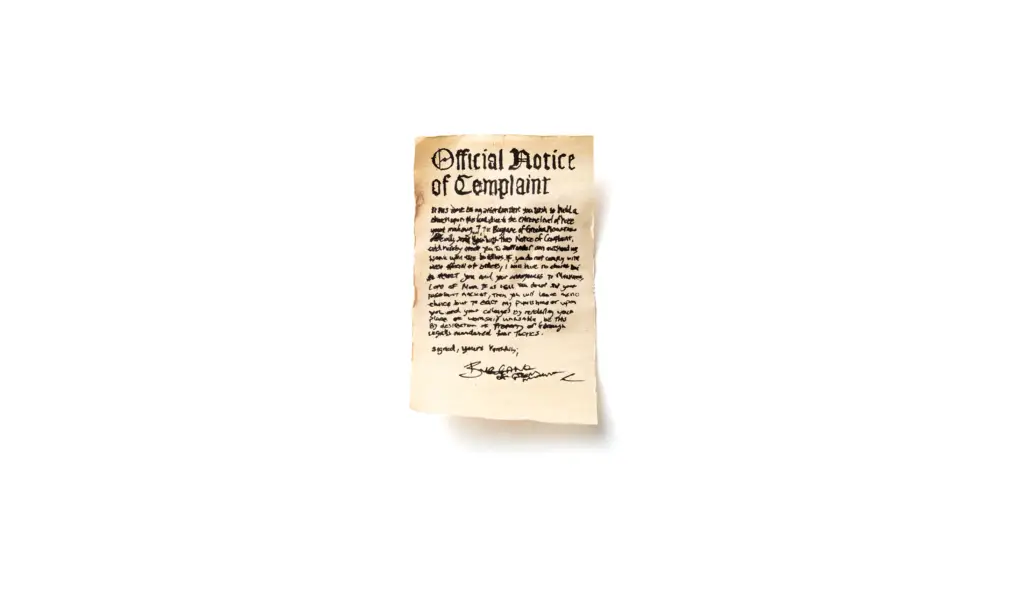
The completed Official Notice of Complaint on tea-stained paper.
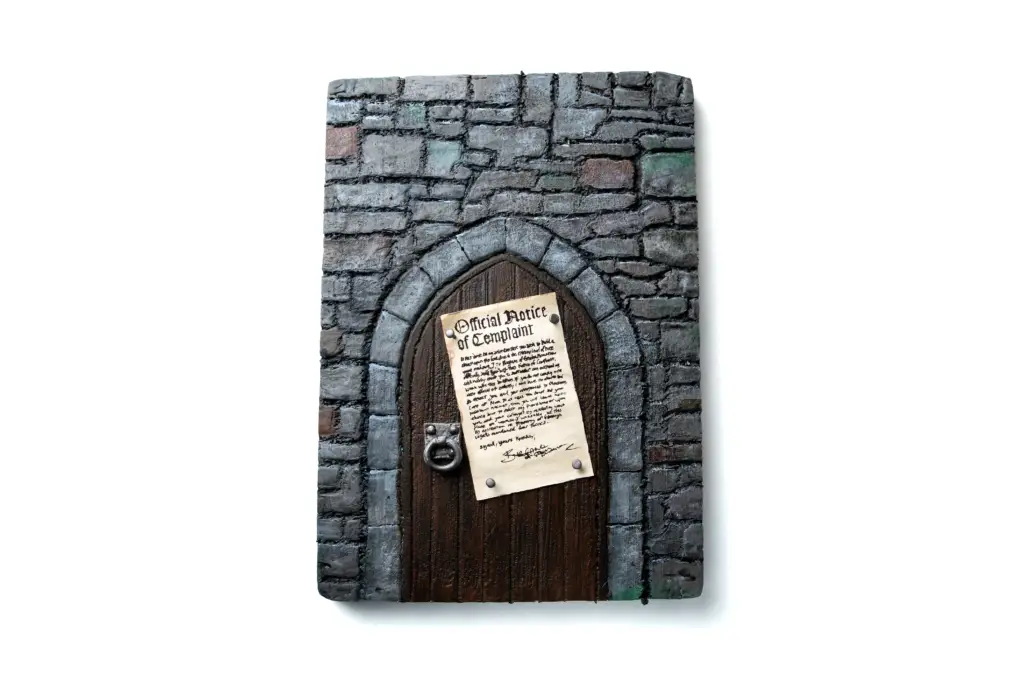
The notice displayed with the completed church-wall and door diorama.
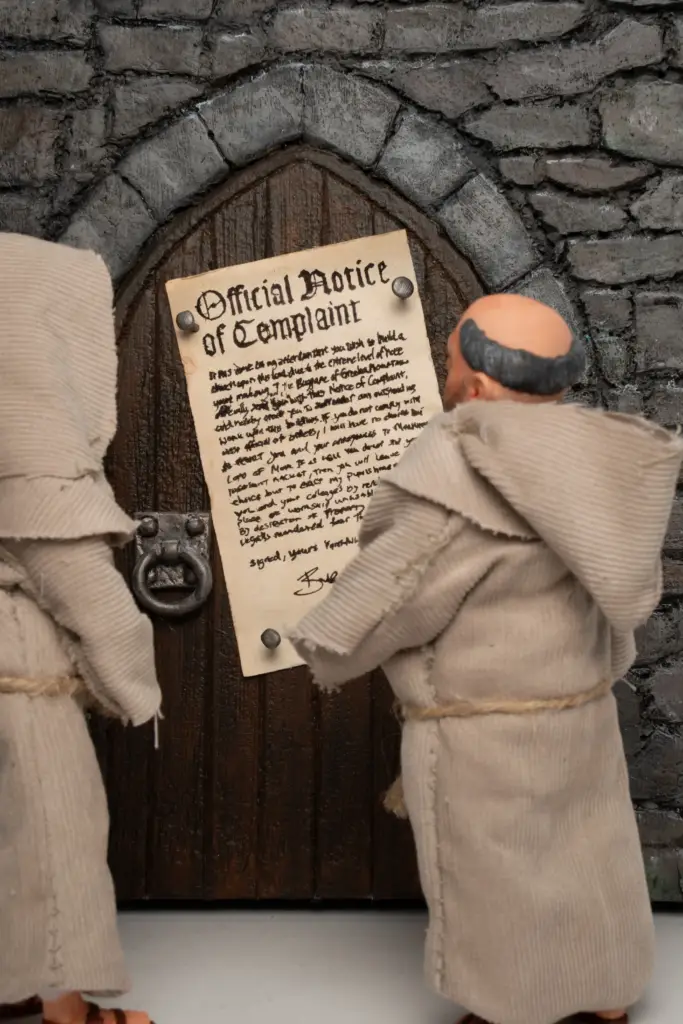
Close-up showing how the graphic prop interacts with the handmade environment,
Marown Marker
The Marown marker was created to establish the location where the church roof would land after being thrown by the Buggane. I could not find convincing evidence for a marker of this exact form in the proposed period, so I treated it as a stylised narrative prop rather than a historical reconstruction.
The marker was sculpted from clay and painted using layered grey tones. The main place name was written in English so that it could be understood quickly by the viewer. I also included a second inscription inspired by Ogham, although this should be treated as a visual experiment rather than an accurate historical transliteration.
I mounted the finished marker on a painted foam base and surrounded it with real sphagnum moss. This created a small landscape in which the object could be photographed and helped connect it with the handmade surfaces used elsewhere in the project.
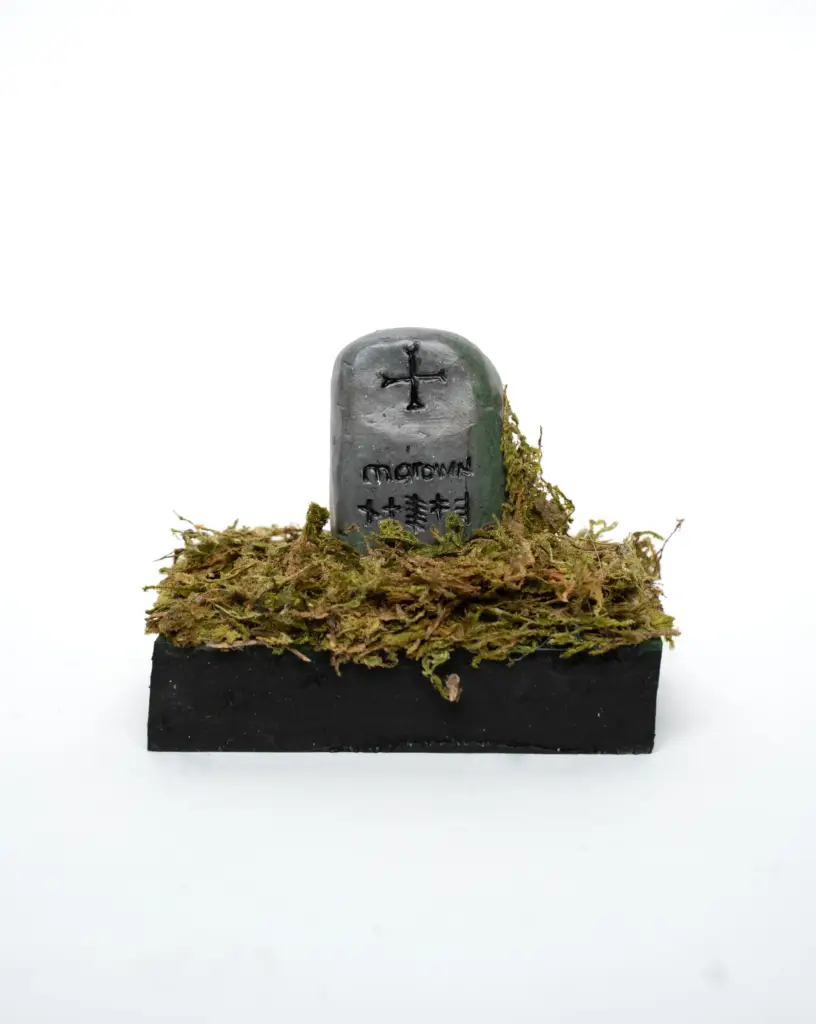
The completed Marown marker within its miniature landscape.
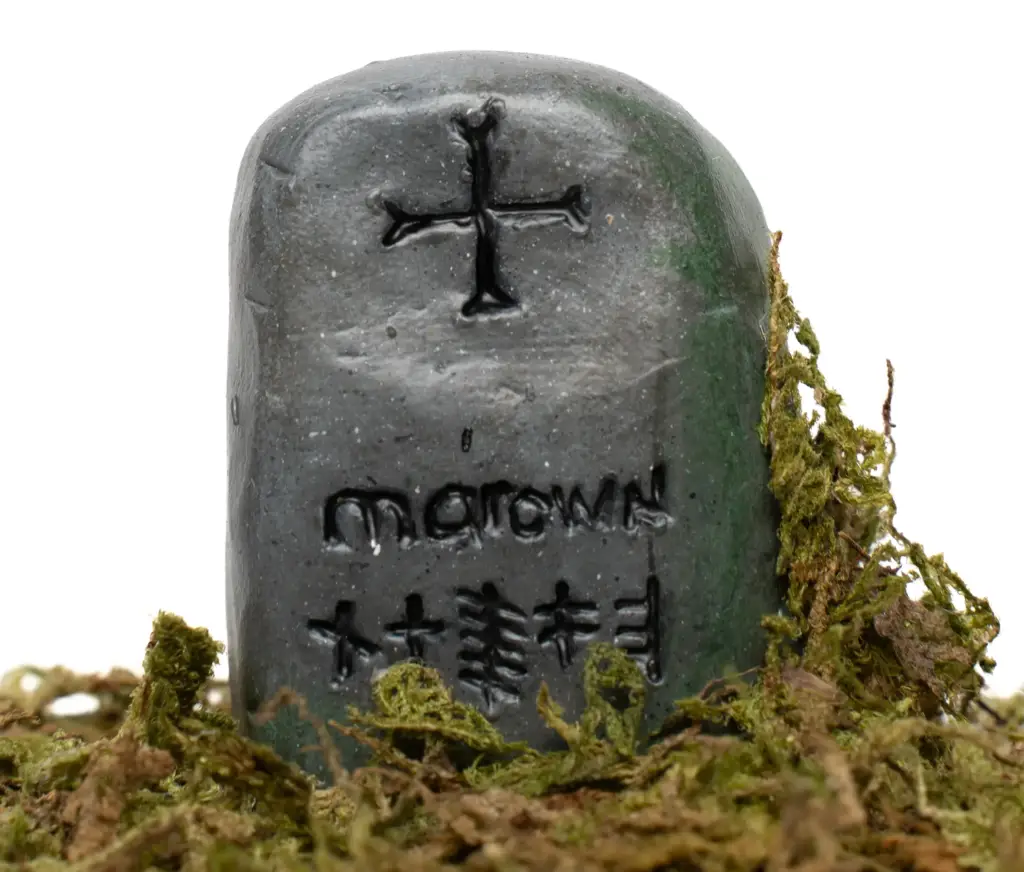
Close-up detail of the carved lettering, painted surface and secondary inscription.
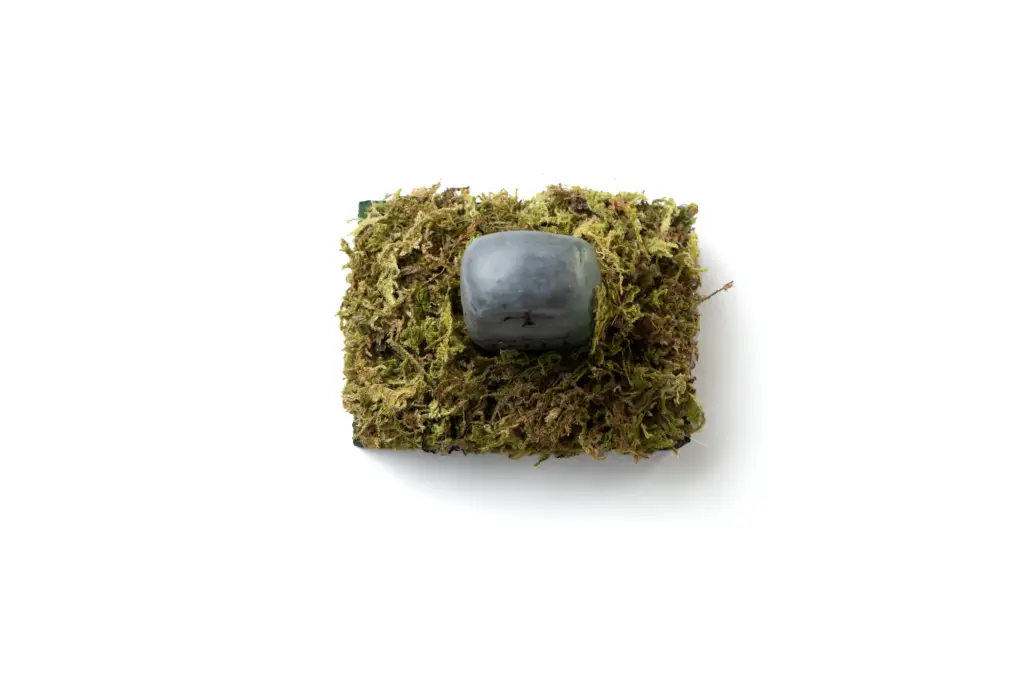
Top-down view showing the marker’s position within the moss-covered miniature landscape.
Script & Storyboard
Alongside the physical outcomes, I completed a working script and rough storyboard for the proposed film. These establish the story structure, deadpan tone and intended position of the graphic props.
The storyboard is deliberately loose and was created to communicate framing and sequence rather than operate as a polished animatic. It shows where the architectural plans, complaint notice and Marown marker would appear within the wider narrative.
Although the complete film was not produced, the script and storyboard give the individual objects a clear function. They demonstrate that the props were designed as parts of a story rather than as unrelated standalone artefacts.
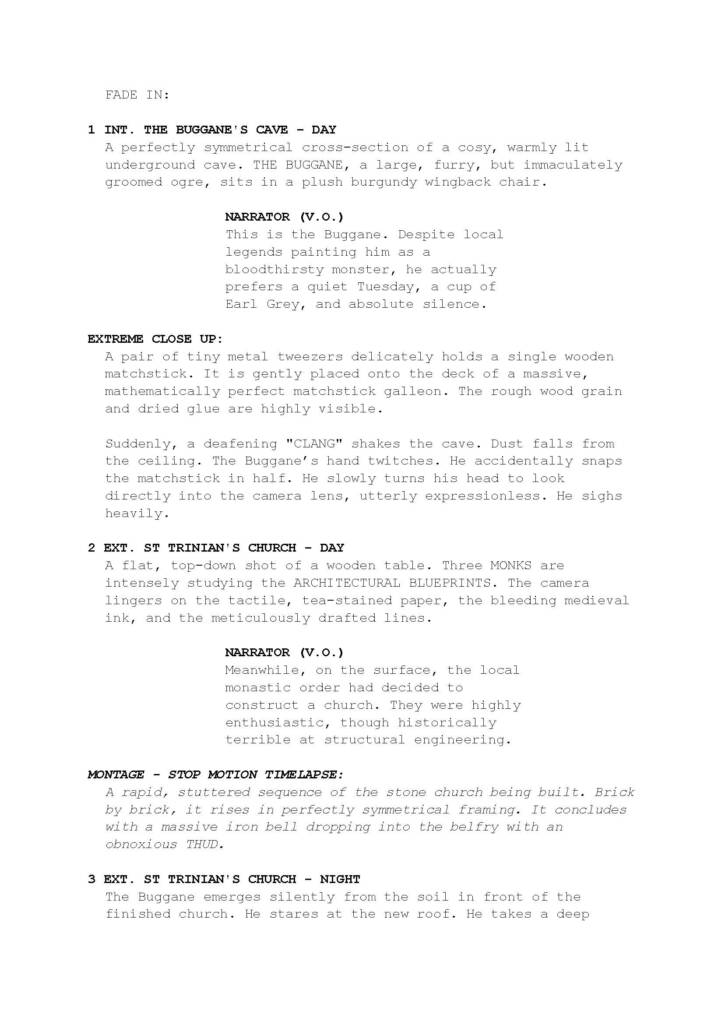
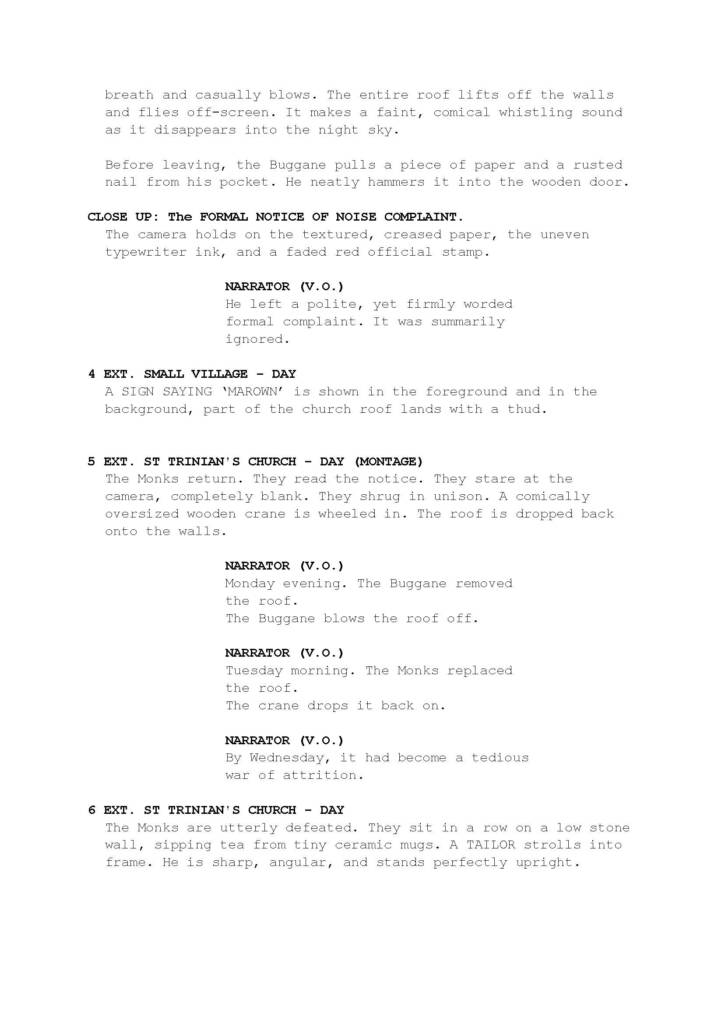
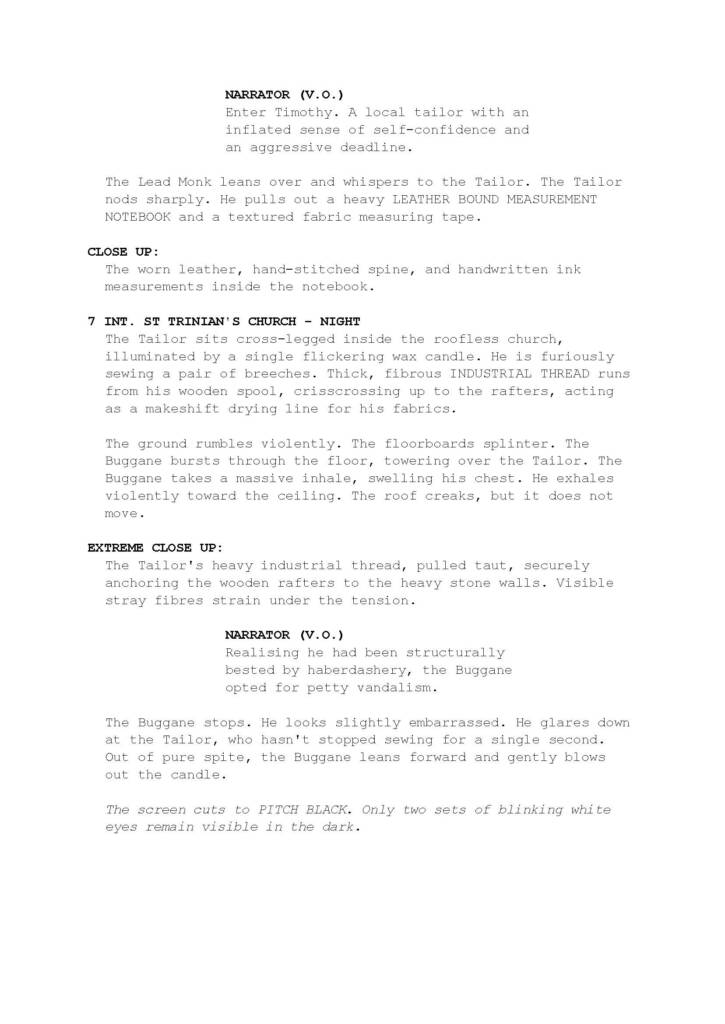
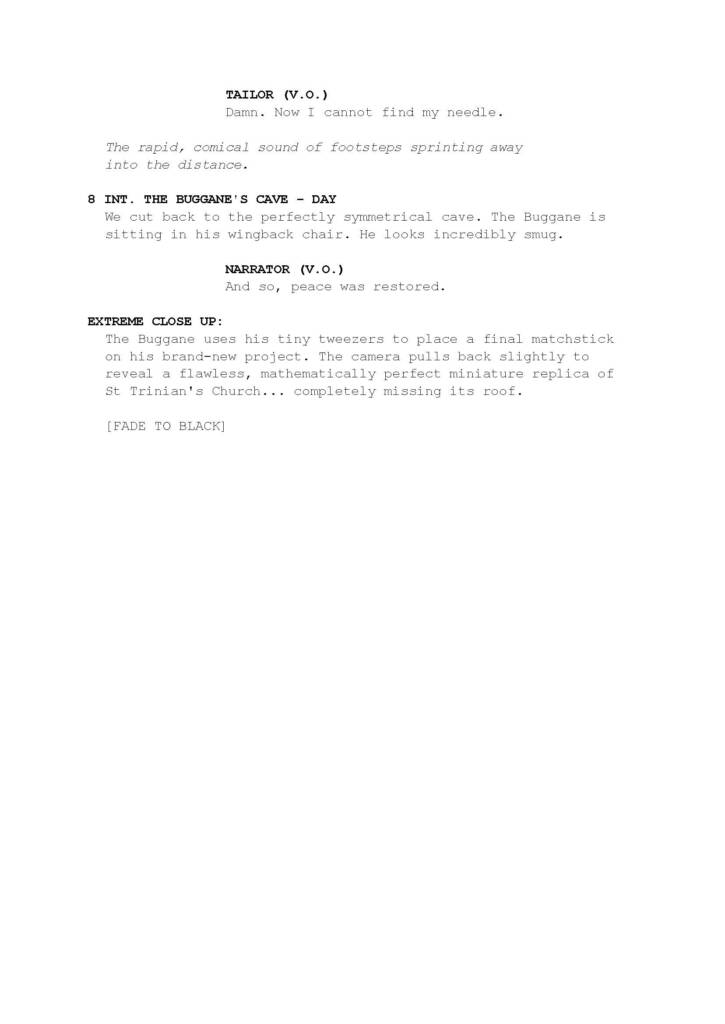
The working script developed for the proposed stop-motion film.
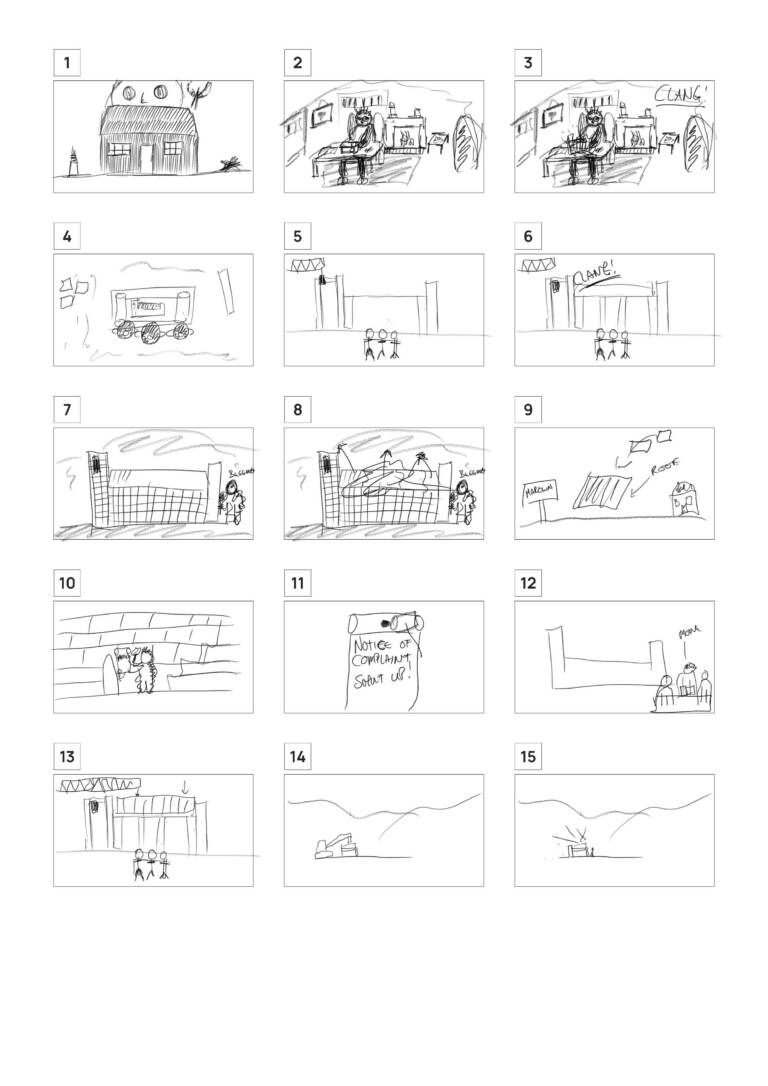
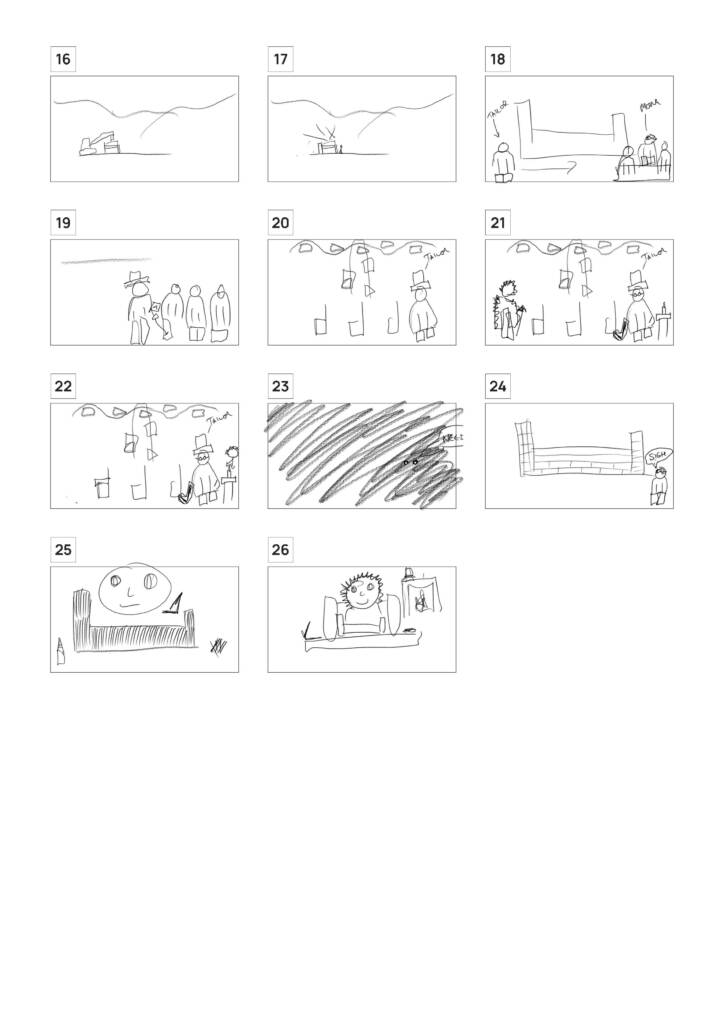
The complete twenty-six-panel storyboard, showing the intended narrative position of the graphic props and physical outcomes.
Changes to the Final Scope
The original proposal included a complete Buggane cave, a larger church environment, matchstick models, motion tests and a finished animatic. These elements were not completed.
After taking time away from the project for personal reasons, I reassessed what could realistically be achieved within the remaining production period. I decided to focus on completing the strongest possible group of physical outcomes rather than spreading the remaining time across several unfinished sets and animation tests.
The final practical package therefore consists of:
- One completed Buggane puppet with interchangeable faceplates
- Three monk bodies, including two clothed versions
- A set of church architectural plans
- An Official Notice of Complaint
- A church-wall and door diorama
- A Marown marker and miniature landscape
- A completed script
- A rough storyboard
This is smaller than the project I originally imagined, but it provides a more honest and coherent proof of concept.
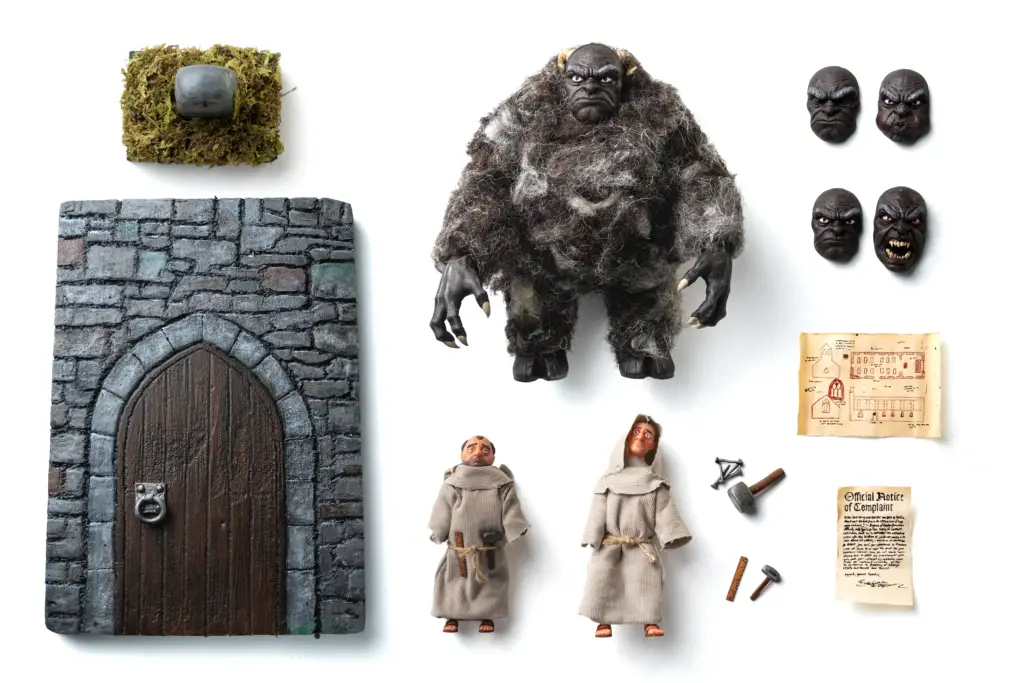
The complete collection of puppets, graphic props and miniature environments produced for the project.
Final Reflection
My research question asked:
To what extent do tactile graphic props and period-accurate ephemera contribute to narrative immersion in motion pictures?
The project cannot provide a definitive answer to this question. I did not produce a finished film or conduct audience testing using the completed props, so I cannot demonstrate that the objects caused viewers to become more immersed in the story.
What the practical work has allowed me to test is how graphic designs change when they become physical objects. Paper weight, ink bleed, carved surfaces, fabric, fur and visible construction all affected how the outcomes appeared through the camera. Details that looked effective on screen during the design stage did not always work at miniature scale, while some physical imperfections became more visually interesting once photographed.
The project also showed me that physical and digital methods do not need to be treated as opposites. Illustrator, Gemini, Tripo AI, Nomad Sculpt and resin printing were used at different stages of development, but the final appearance of the outcomes was determined through physical assembly, painting, distressing, costume-making and photography. Being transparent about that workflow is important because the completed objects combine generated, digital and handmade processes.
Historical research gave the designs a starting point, but several outcomes required deliberate artistic licence. The architectural plans were informed by historical references without being presented as exact reconstructions. The complaint notice was intentionally anachronistic, while the Marown marker was designed primarily to communicate narrative information. These decisions reinforced the importance of describing the outcomes accurately rather than claiming complete historical authenticity.
The final outcomes demonstrate the beginnings of a consistent handmade world and have allowed me to explore an area of graphic design that I would like to continue developing. If I took the project further, the next stage would be to complete the missing puppet components, improve the faceplate and joint systems, construct a wider range of sets and hand poses, and carry out controlled motion and camera tests. This would allow the props to be evaluated through movement and audience response rather than through still photography alone.