Plan for the Week
- Finalise the character designs and proportions for the Buggane, the Monks, and the Tailor
- Research technical armature construction for stop motion puppets
- Determine the physical materials for skin, hair, and clothing to maintain the tactile aesthetic
Character Design: Proportions & Personality
With the environments mapped out in last week’s concept art, my focus has shifted to the inhabitants of St Trinian’s. In stop motion, a character’s silhouette and proportions do a massive amount of the narrative heavy lifting before they even move. Keeping the deadpan, Wes Anderson-inspired tone in mind, I want to ensure the character designs are stylised, slightly geometric, and expressionless.
The Buggane
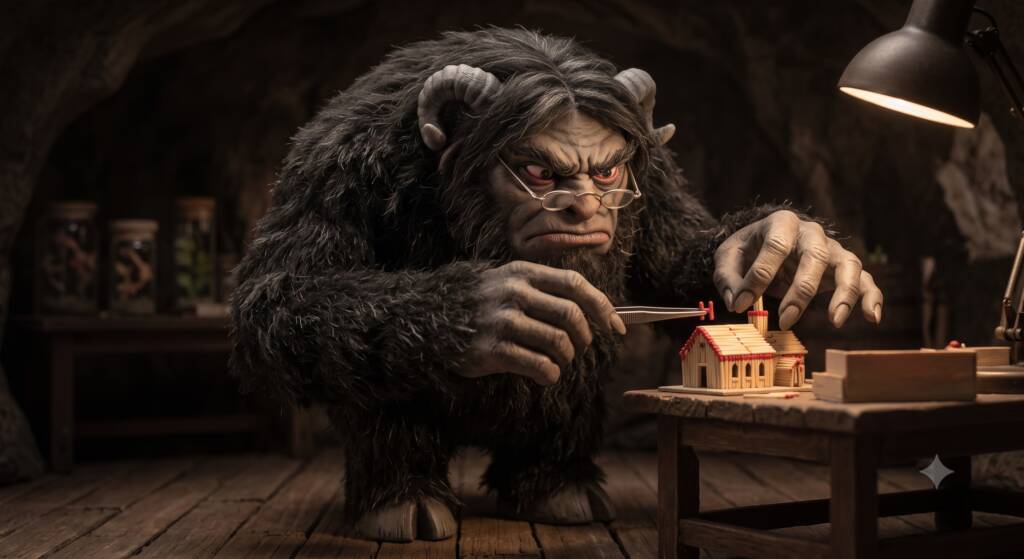
Rather than relying only on my rough sketches, I wrote detailed image-generation prompts for Gemini, using my earlier research and moodboards to describe each character. I am using these images as exploratory concept art rather than finished designs. As the Buggane is a figure from folklore, there are many different interpretations of what it might look like. I wanted to draw some inspiration from characters such as the Gruffalo while retaining details from the story, including the cloven hooves and large hands. I also wanted the images to reference the controlled, symmetrical and slightly deadpan visual style I have been exploring through Wes Anderson’s work.
The prompt below records the ideas I was considering at this stage. Some of its details may change once I begin translating the character into a physical puppet.
Buggane Character Prompt
Silhouette & Proportions
The Face & Head (The Comedic Contrast)
Costume & Grooming
Animation Potential
Prompt Result:
The Monks
Monk One: Brother Barnaby (The Taskmaster)
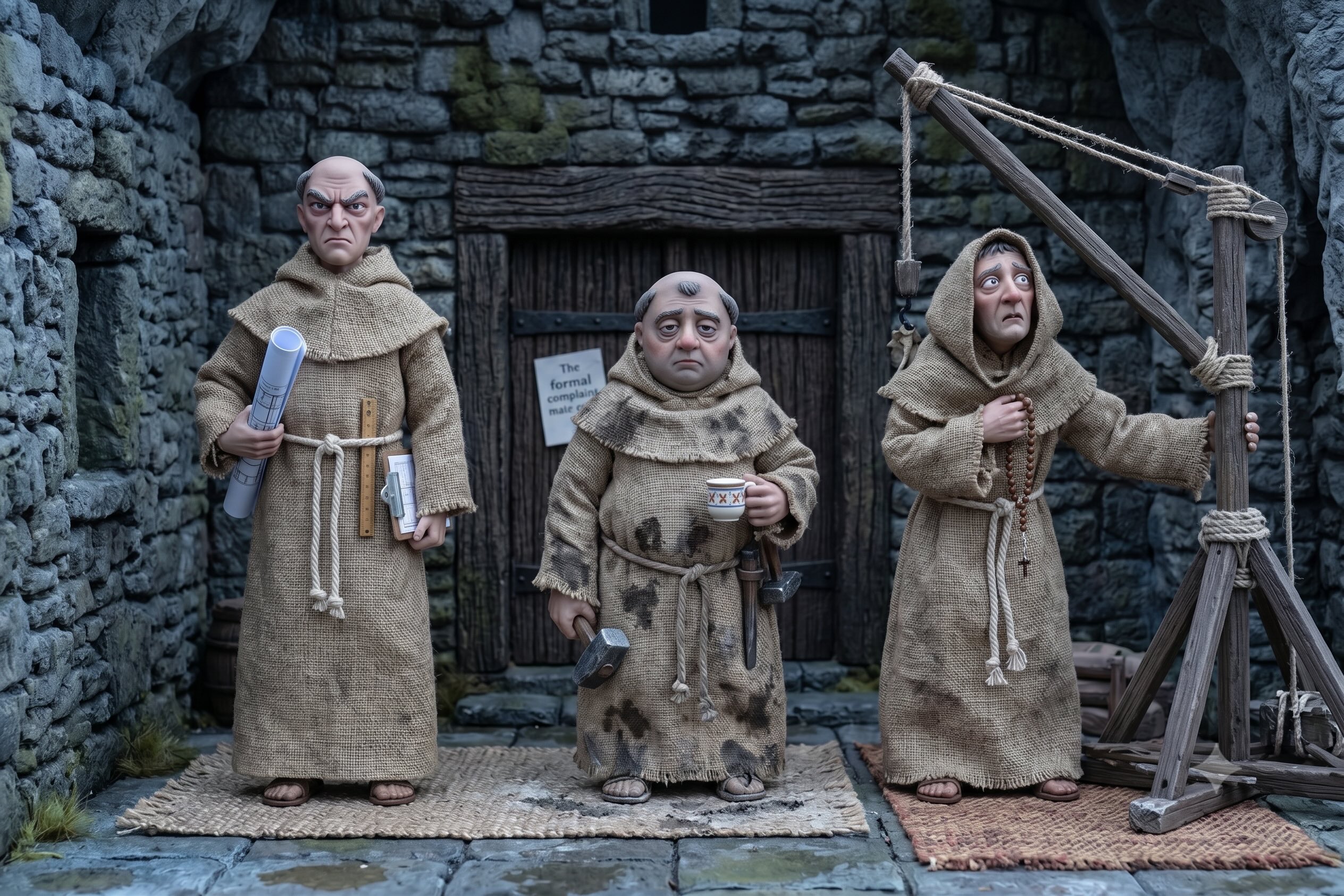
Body & Posture: The tallest and thinnest of the three. He stands uncomfortably straight, clutching a rolled-up copy of the architectural blueprints under his arm like a military baton.
Facial Expression: A permanent, tense scowl. He is the eternal optimist of the group, utterly convinced that this time the roof is going to stay put.
Prop Detail: Always seen holding a tiny wooden clipboard or pointing aggressively at the church walls with a measuring rule.
Monk Two: Brother Melvyn (The Weary Realist)
Body & Posture: Short, round, and permanently slouched. His posture screams total defeat. He carries the heavy lifting tools (like the masonry hammers and chisels) with a heavy, dragging shuffle.
Facial Expression: Heavy-lidded, droopy eyes that stare blankly into the middle distance. He has completely accepted that the Buggane is going to blow the roof off again.
Prop Detail: Almost always seen holding his signature tiny ceramic tea mug, waiting for the inevitable disaster.
Monk Three: Brother Thomas (The Nervous Wreck)
Body & Posture: Medium height, constantly twitchy, and hugging his own shoulders. He is deeply stressed by the supernatural presence of the cave monster.
Facial Expression: Wide, frantic eyes that constantly dart up toward the sky, anticipating the next gust of wind.
Prop Detail: Often clutching a string of prayer beads or nervously fiddling with the rope rigging of the oversized wooden crane.
Uniformity vs. Individuality
While their robes should be cut from the same rough, coarse hessian or un-dyed wool to maintain the cold, miserable church aesthetic, small details will set them apart. Brother Barnaby’s robe can be neatly cinched with a rope belt, Brother Melvyn’s robe can be slightly lumpy and stained with mortar, and Brother Thomas’s hood can be pulled halfway down over his face in a state of constant anxiety.
Prompt Result:
The Tailor
Silhouette & Posture
The Body: Tall, slender, and rigidly vertical. He stands with an exaggerated, upright posture, striking dynamic poses with his hands on his hips to show off his complete lack of fear.
The Contrast: His sharp angles and sleek silhouette visually slice right through the heavy, rounded shapes of the Buggane and the slumping forms of the monks.
Costume & Tailoring
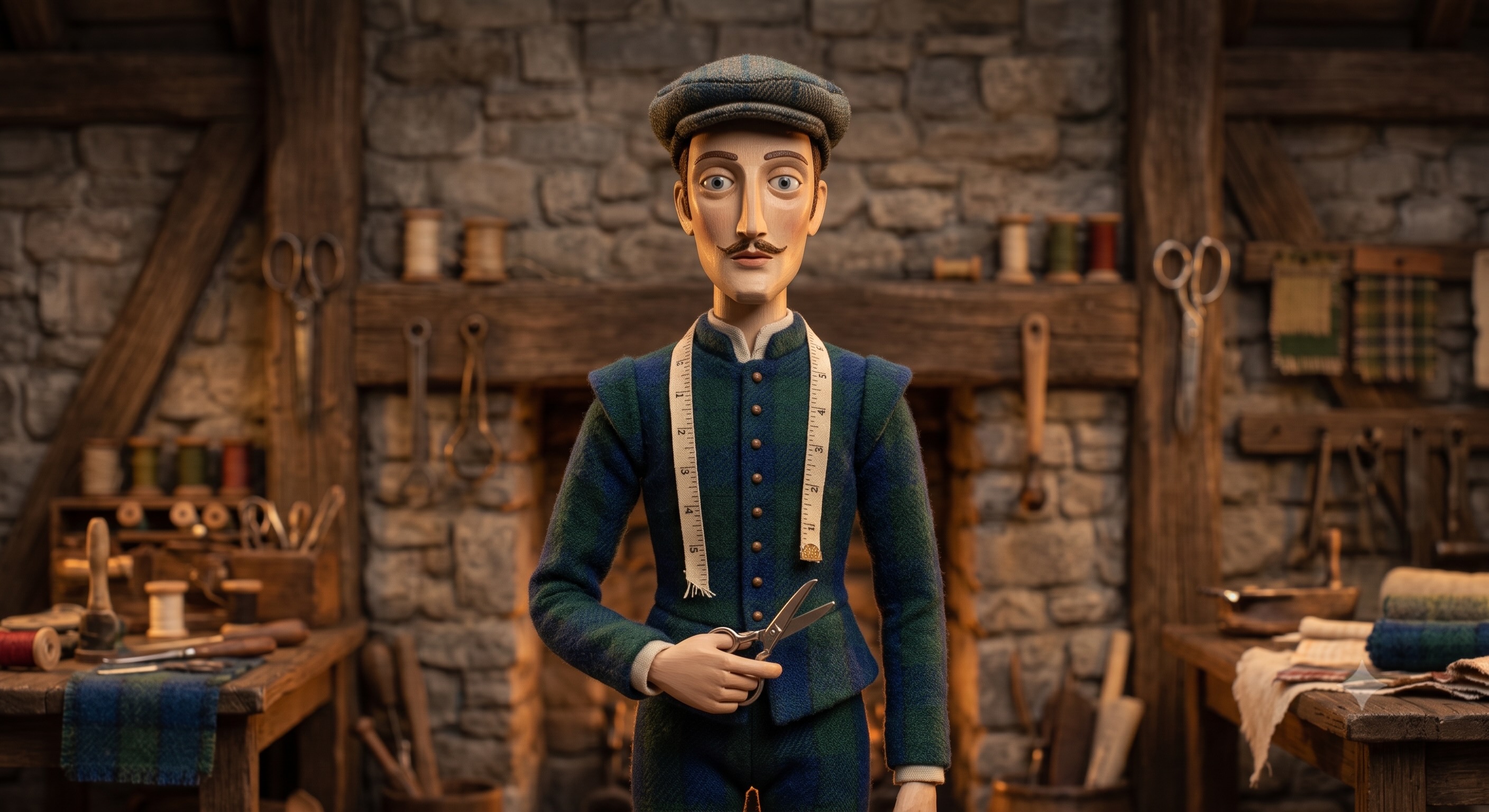
The Look: A sharp, immaculately tailored three-piece suit or waistcoat combo crafted from tightly woven, crisp cotton or fine felt. Crafted tastefully from a Manx inspired tartan.
The Details: To emphasise his profession, he should have a physical measuring tape draped permanently around his neck, tiny silver scissors tucked into a breast pocket or hand, and a pincushion strapped to his wrist. His clothes are completely pristine—at least until the middle of the night when he starts sewing inside the roofless church.
The Face & Expression
Facial Features: He has sleek, sharp features, a tiny waxed moustache, and a slightly vacant, dimwitted expression with wide, uncomprehending eyes.
Expressionless Deadpan: True to the Wes Anderson style, his face remains entirely fixed and serious, even when a massive ogre bursts through the floorboards beneath him. He simply keeps right on sewing.
Animation & Prop Integration
The Tools: His primary interaction with the physical world is mechanical and hyper-fast. When he takes measurements, his hands snap with robotic precision, slapping the leather-bound notebook open and whipping out the measuring tape.
Prompt Result:
Technical Armature Research
A puppet may look convincing as a still object, but it also needs to hold its pose when placed under the studio lights. I therefore spent part of this week researching the internal skeleton of a stop-motion puppet, known as the armature. I compared two common approaches to see which would be most suitable for my budget, available tools and proposed proof-of-concept tests.
Ball-and-Socket Armatures
Ball-and-socket armatures use precisely made metal joints and are often used in professional stop-motion production. They can provide smooth, controlled movement and are designed to withstand repeated adjustment. However, they can be expensive and may require specialist components or machining, particularly when made to fit a specific puppet design.
Aluminium Wire Armatures
A more accessible alternative is a twisted aluminium-wire armature. The wire creates flexible joints without requiring the same level of specialist engineering. Rigid materials such as epoxy putty can be added around the bones so that bending occurs mainly at the intended joints. The wire can still fatigue and eventually break after repeated movement, but it should be suitable for a limited proof-of-concept build if constructed carefully.
The Decision
Given the timeline and budget of the project, I currently plan to use aluminium-wire armatures reinforced with epoxy putty. This should give the puppets enough stability for posed photography and short motion experiments without making the construction process unnecessarily complicated. I will need to test the armature before deciding how successful it is in practice.
Materials & Tactility
Because my research is concerned with physical materiality and the audience’s response to texture, the materials used for the puppets are as important as the graphic props. I want to avoid surfaces that appear overly smooth or plastic unless that finish is deliberately required, as this could weaken the handcrafted character of the proposed production.
The Buggane’s Fur
I am planning to experiment with needle-felting wool over a foam body to create the Buggane’s fur. Felted wool could give the puppet the textured, handmade appearance I want, although loose fibres can move between frames and create a visible ‘boiling’ effect during animation. I will also need to test whether the foam provides a secure enough surface for the wool. If not, attaching sections of fur using adhesive may be a more practical alternative.
Clothing
The Monks will be clad in rough, coarse fabrics like hessian or heavy, un-dyed wool to make them look appropriately miserable and medieval. The Tailor, conversely, will be dressed in crisp, tightly woven cotton or fine felt to reflect his precise profession.
Heads & Hands
For the heads and hands, I plan to combine digital sculpting with resin 3D printing. Once cured, the resin can be sanded and painted with acrylics. A matte finish should help reduce harsh reflections from the LED lights and prevent the surface from looking overly plastic in close-up photography. The characters will generally use restrained expressions to support the dry comedy of the concept, although the Buggane may require several interchangeable faces for particular actions.
Next Week
I will consolidate all of this research, alongside my prop lists and environment sketches, into one final Master Asset List to prepare for the physical making phase of my proof of concept.