Plan for the Week
Finalise script for entire video
Storyboard script into scenes
Run through script and storyboard, pick out achievable prop and production list
Assure everything in ready for the next stage of preproduction
Finalising the Script
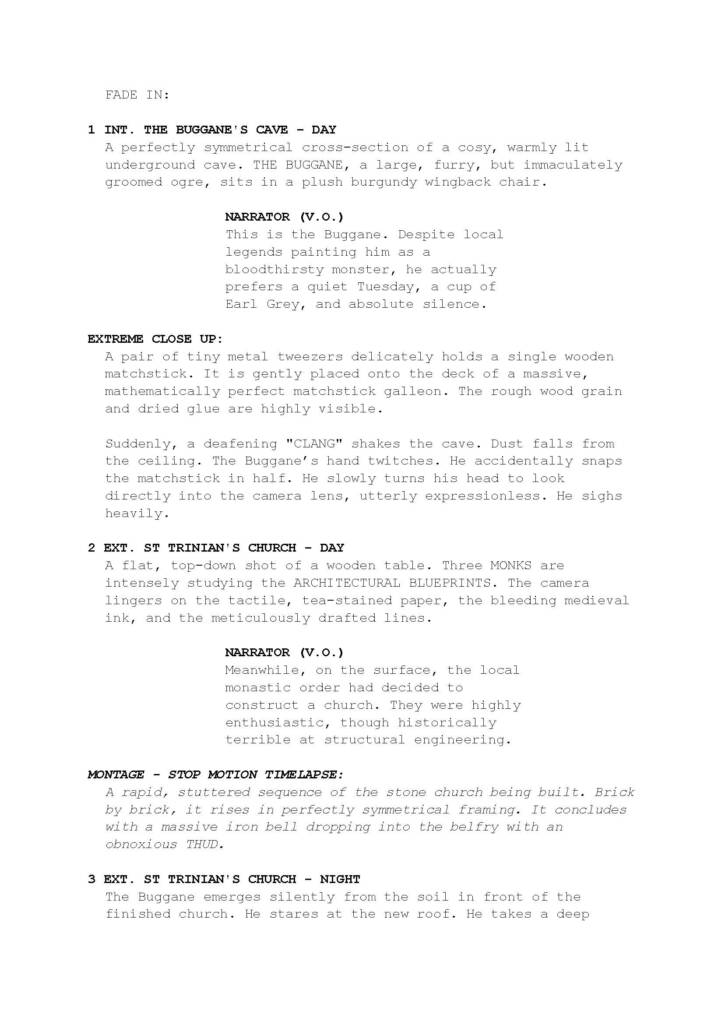
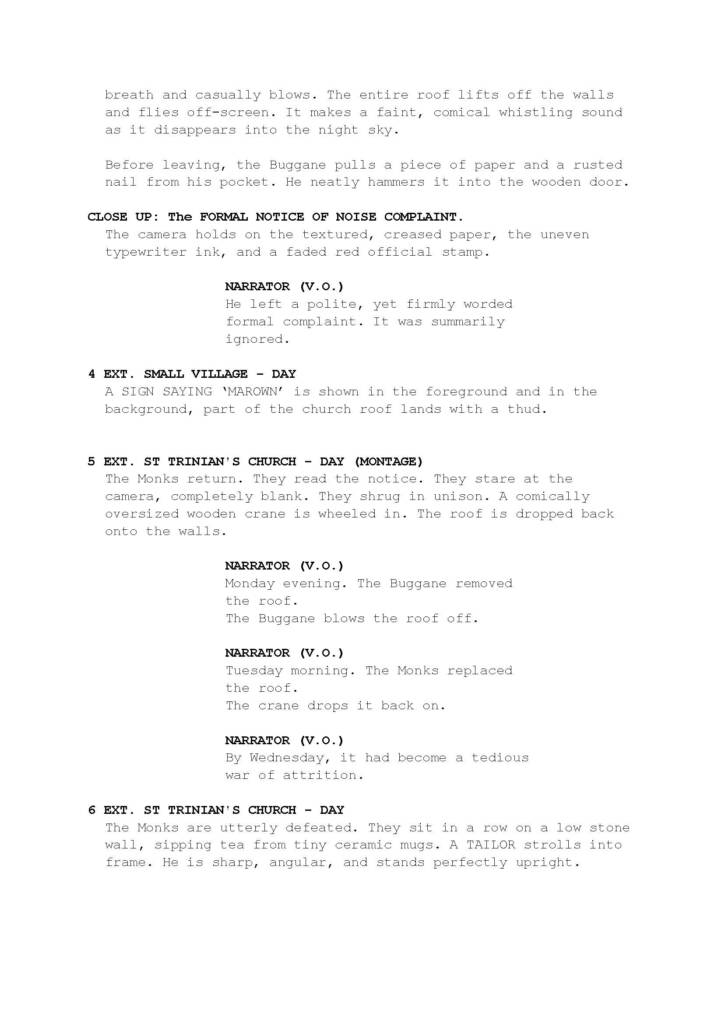
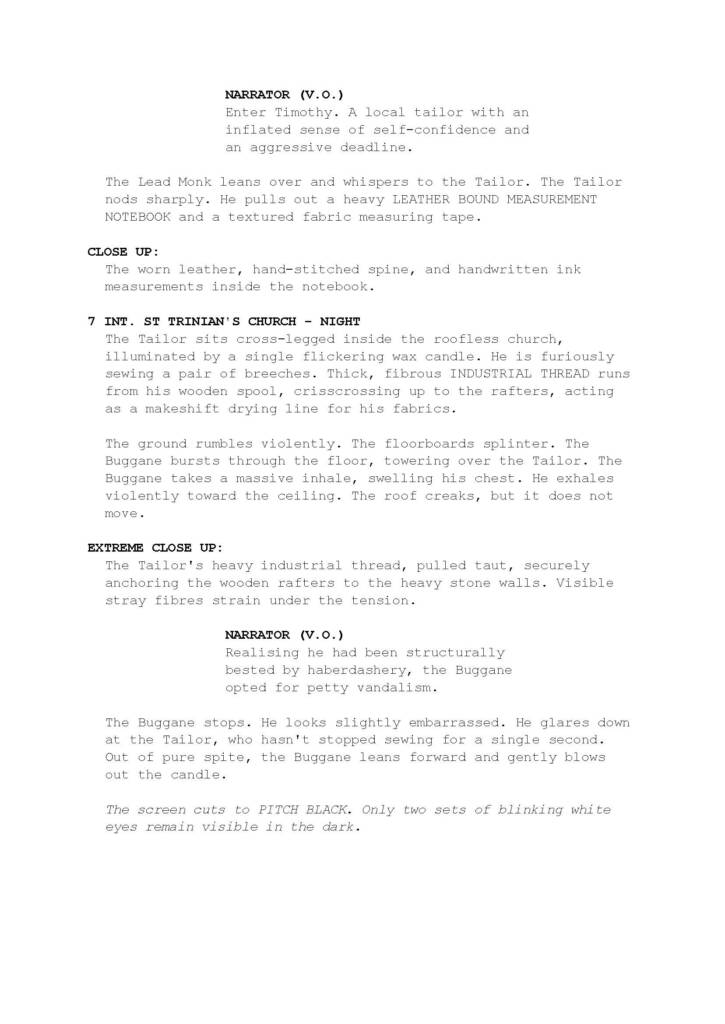
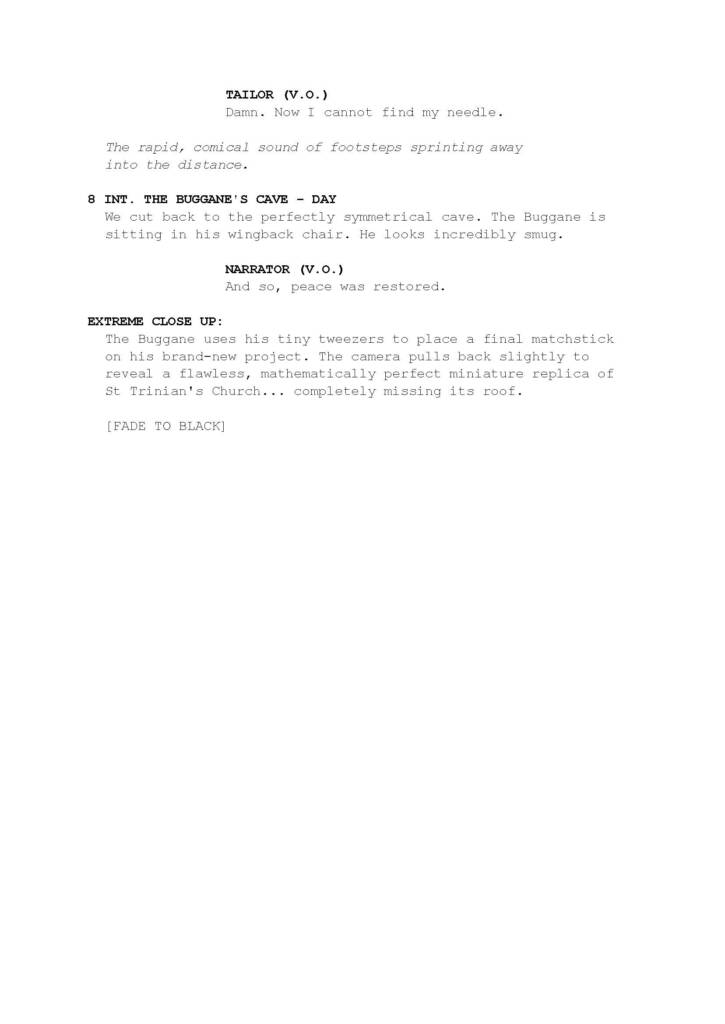
Having already compiled the main story beats, I used this week to turn them into a complete working script. This would allow me to look through the story and identify which characters, props and environments were most important, before deciding what could realistically be produced for the proof of concept.
The finalised script is included below:
Storyboarding the Script
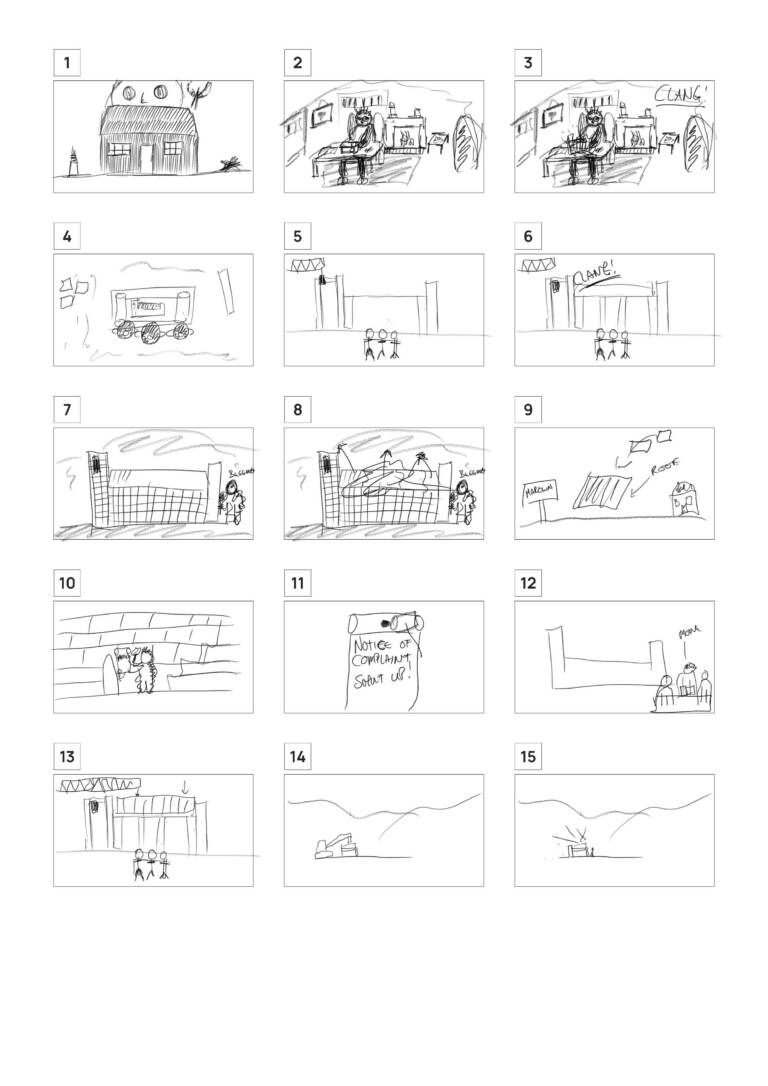
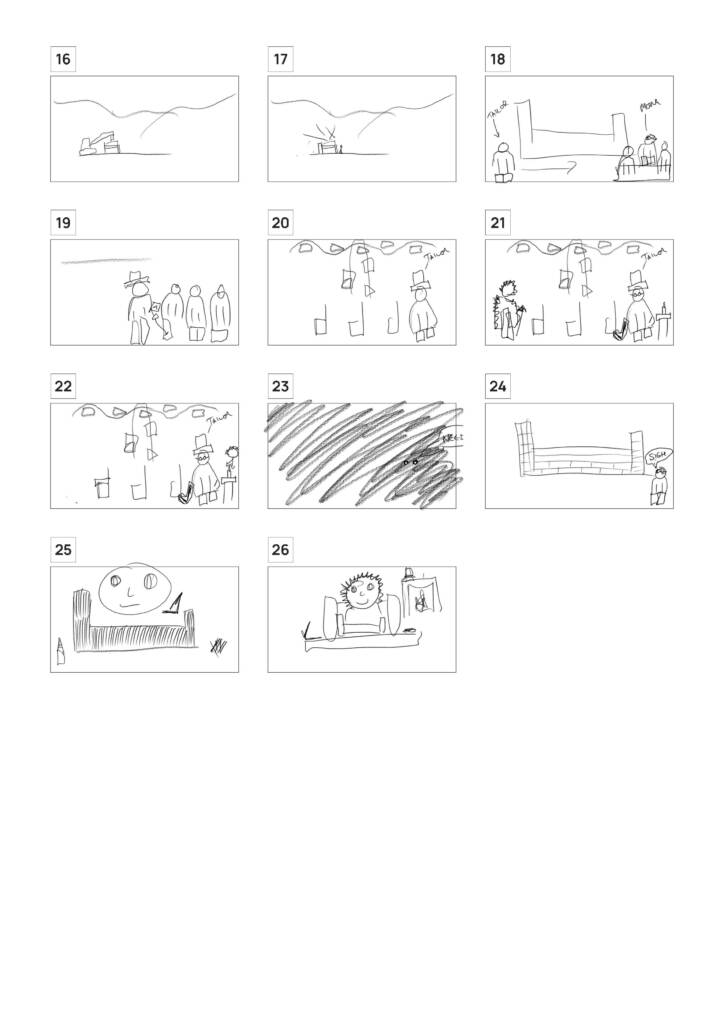
Although I don’t plan on producing the entire film for my concept proposal, I wanted to create a very basic storyboard showing the key moments from the script. These are deliberately rough and quick sketches of what would appear on screen. I didn’t want to spend too long developing detailed storyboard panels at this stage, as I already have a lot to produce within the time available for this module.
Choosing Assets to Produce
Now that I have completed the script and rough storyboard, I need to decide which items I want to produce for the proof of concept.
I would love to work through every aspect of production and produce the finished film, but that isn’t realistic within the module timescale. Instead, I need to prioritise a selection of puppets, props and environments that will communicate what the production could look and feel like if it were developed further.
Master Asset List & Reasoning
- Puppets
- Buggane
- Monks (At Least One)
- Hero Props
- Church Blueprints/Plans
- Formal Notice of Complaint
- Marown Sign
- Environment/Sets
- Buggane’s Cave
Buggane – Puppet
Being the ‘star of the show’, the Buggane is the most important puppet to produce. My aim is to make a proof-of-concept puppet that can hold a range of poses and, if time allows, be used for some short movement tests. I would also like to create several interchangeable faces, concentrating on a small number of expressions rather than attempting the much larger replacement system that would be needed for a finished production.
The expressions I plan to produce are:
- Resting face
- Resting face with eyes closed
- Blowing
- Anger
Alongside these expressions, the Buggane will need an internal armature so that the body can be posed. Interchangeable hands would also be useful, although these will depend on how much production time is available.
Monks – Puppets
For this proof of concept, I would like to produce at least one monk to show the difference in scale between a human character and the Buggane. If time allows, I would ideally produce all three, as their different heights and body shapes are an important part of their character designs. At least one should include a poseable armature and clothing, allowing me to explore the difference between constructing the monks’ fabric costumes and the Buggane’s felted fur. Their faces can remain static for this stage, although they could be designed so that replacement heads or faces could be added in a future production.
Church Blueprint/Plans – Hero Prop
Creating a hero prop is important to this proof of concept, and I want the church plans to feel handmade and appropriate to the world of the story. Rather than resembling precise modern blueprints, they should look like hand-drawn architectural plans made using aged paper, ink and rough measurements. As there may be limited surviving reference material from the period, the result will be historically informed rather than presented as a completely accurate reproduction.
Formal Notice of Complaint – Hero Prop
Like the church plans, the formal notice is an important story prop and will need to work at the correct scale alongside the puppets and environment. The idea of the Buggane submitting an official written complaint is deliberately absurd, so the prop does not need to be completely historically literal. However, its paper, lettering and construction should still feel believable within the visual world of the film.
Marown Sign – Prop
Although this prop would only appear briefly, it would allow me to produce something different from the paper-based hero props. I need to research the appearance of historic Manx boundary markers and village signs, although suitable visual evidence may be limited. If I cannot find a definitive historical reference, I will use the available research as a starting point and make the remaining design decisions clear as artistic interpretation.
Buggane’s Cave – Environment
Depending on the remaining production time, I would also like to create part of the Buggane’s cave interior. This would be the most detailed environment to produce, requiring furniture and smaller background objects that match the scale of the Buggane puppet. It would present an interesting challenge, particularly in making a cave feel surprisingly cosy and lived-in. If a complete set proves too ambitious, I could instead produce a smaller section that communicates the intended materials and atmosphere.
Planning for Phase Four
Now that the main pre-production elements are in place, including the story, character concepts, environments and initial prop list, I can begin planning Phase Four: production. During this phase, I will construct the selected assets and document the processes used. Before starting, I need to break each asset down into the likely materials, tools and software required. This list will remain provisional, as I may need to adapt the methods or materials once construction begins.
I appreciate that stop-motion films are extremely time-consuming and are normally produced by large teams over long periods. Restricting the number of assets should give me a realistic chance of producing a convincing proof of concept, but I will need to monitor the timescale carefully and avoid spending so long perfecting one object that other important elements are left unfinished.
Initial Material List
Buggane Puppet
Materials
- Aluminium Wire 1mm – for wrapping and securing movable joints
- Aluminium Wire 3mm – for the majority of the skeleton armature
- Foam – thin sheets, 1mm to be wrapped around the armature to give it bulk and to hold it in place
- Milliput – two part epoxy putty to be used as ‘bones’ for immovable parts of the skeleton such as arms and legs, leaving just the ‘knee’ or elbow free to move
- Neodymium Magnets – various sizes to attach the moulded/prints hands, feet and heads/faces to allow easy replacement without moving the puppet
- Super Sculpey Clay – oil based clay for hand sculpting the hands/hooves and face/head – unsure of skill with clay so back up of 3d modeling
- Masking Tape – to wrap around the aluminium armature to give the foam a better surface to adhere to
- Soft Toy stuffing fibre – for bulking out the body to give the puppet the required body proportions
- 3D Print Resin – to be used in my Anycubic 3D Resin Printer – ideally water based to speed up cleaning and minimise chemical use
- Model Paint – used in painting the finished body parts such as head, feet and hands
- Untreated Sheep Wool – Dark Grey/Black – used to felt the Buggane’s fur over his body
- Craft Mount Spray – to adhere the foam to the masking tape layer
- Super Glue/Hot glue gun sticks
Tools
- Scissors
- Wirecutting pliers
- Craft knife
- Cutting mat
- Clay sculpting tools
- Paint brushes
- Hot Glue Gun
Software
- Nomad Sculpt – iPad App for 3D Modelling
- ChiChuBox – 3D Print Slicing and Support
- Google Gemini – Concept Art
Monk Puppet/s
Materials
- All materials mentioned above
- Hessian Sheet Fabric – used to create the monks robes
- Sewing Thread – colour to match the material of the robes
Tools
- All tools mentioned above
- Sewing Machine – used to stitch together the robes
- Sewing Needles
- Sewing pins
Software
- All software mentioned above
Props
- All materials mentioned above
- Appropriate weight paper for paper based props
Tools
- All tools mentioned above
- Inking Tools such as quill and ink
Software
- All software mentioned above
Environments/Sets
Materials
- All material mentioned above
- Air drying clay – for modeling small additive props to fill out environment
- Plaster of Paris – to model and sculpt the walls of the cave
- Balsa Wood Sticks – 3x3mm – to be used for various filler props and furniture
- Balsa Wood Sheets 200x100mm – to be used for various filler props and furniture
- Toothpicks – to be used for various filler props and furniture, including the Bugganes models if production time allows
- High Density Foam Board – 30x20cm – to used for various set additions and furniture (could also be used for church walls if production time allows)
Tools
- All tools mentioned above
Software
- All software mentioned above
Week by Week Plan
To ensure an efficient workflow and to keep this project achievable, I want to set myself a realistic timeline of production and testing. Things will inevitably go wrong, whether that be with my skills or the materials but I want to make sure I get this project over the finish line without the customary last seven day panic and rush. The below week by week plan is an estimate on what I’ll be able to produce in the required timeframe.
Week 13: Character Fabrication (Armatures & Bodies)
- The Buggane’s Skeleton: Constructing a fully posable aluminium wire armature for the Buggane, ensuring it is robust enough to handle various different poses for the character motion tests.
- The Monk (Scale Reference): Building at least one fully posable Monk armature. This will act as a vital visual reference to show the drastic difference in scale and weight between a standard human and the massive Buggane.
Week 14: Character Fabrication (Faces & Costuming)
- The Interchangeable Expressions: 3D printing and painting the four priority facial expressions for the Buggane: Resting (expressionless), Resting with eyes closed (for blinking or deep thought), Blowing (contorted to show physical effort), and Anger (full teeth on show for the Tailor interaction).
- The Static Monk: Sculpting a static head for the Monk, keeping in mind that it can be upgraded to an interchangeable system in future productions.
- Costuming & Fur: Needle-felting the Buggane’s raw wool exterior and fabricating the coarse clothing for the Monk to highlight the different production methods between fur and textiles.
Week 15: Hero Prop Fabrication (Paper Ephemera)
- The Church Blueprints: Hand-drawing the medieval architectural plans on period-accurate paper. Focusing on rough sketching and approximation rather than exacting, modern architectural details to keep it historically grounded.
- The Formal Notice of Complaint: Crafting this vital story beat to exact scale, ensuring the typewritten text and paper textures fit perfectly within the tactile environment.
Week 16: Hero Prop Fabrication (Signage) & Peer Review
- The Marown Sign: Researching historic and current town signposts to create a highly detailed, non-paper prop. This provides a brilliant opportunity to test and photograph weathered wood or metal textures under the macro lens.
- Academic Alignment: Participating in the peer review for the Critical Report draft to ensure the theoretical framework is on track.
Week 17: Environment Construction (The Buggane’s Cave)
- The Cozy Lair: Depending on production time, building the highly detailed interior of the Buggane’s cave. This will present a real technical challenge to make the space look warm and ‘cozy’ on camera.
- Set Dressing: Fabricating the smaller background props, miniature furniture, and ephemera that match the scale of the Buggane puppet to populate the cave diorama.
Week 18/19: Proof of Concept Photography & Report Assembly
- Macro Photography: Placing the Church Blueprints, the Notice of Complaint, and the Marown sign under the macro lens to capture high-resolution pitch imagery, proving the physical distressing translates into genuine three-dimensional depth on screen.
- Character Motion Testing: Shooting short, posed animation tests with the Buggane to demonstrate the interchangeable faces, armature posing, and the interchangeable hands.
Week 20: Post-Production (Editing & Grading)
- Assembling the Cut: Editing the character motion tests and the animatic together into a cohesive pitch video.
- Colour Grading: Enhancing the final test footage to ensure the warm, cozy cave tones and the cold, flat exterior concepts contrast perfectly against each other.
Week 21: Studio Practice PDF Assembly
- Formatting the Pitch: Compiling the Studio Practice PDF. Dedicating roughly 50 to 60 pages to the research and development journey, and 10 to 20 pages to showcasing the final proof of concept outcomes, hero props, and motion tests.
Week 22: Critical Report Final Polish
- Academic: Reviewing the 5000-word academic essay to ensure it avoids conversational terminology and jargon, making it accessible for a general readership.
- Referencing: Checking that all citations adhere strictly to the Falmouth University Harvard referencing style.
Week 23: Final Submission Prep & Blog Formatting
- The Research Journal: Ensuring the online blog is completely up to date, clearly detailing the creative rationale and evaluating the research findings throughout the module.
- Submission: Preparing for the final submission and launch of the MA project, ensuring all files are compressed and ready to upload well ahead of the deadline.